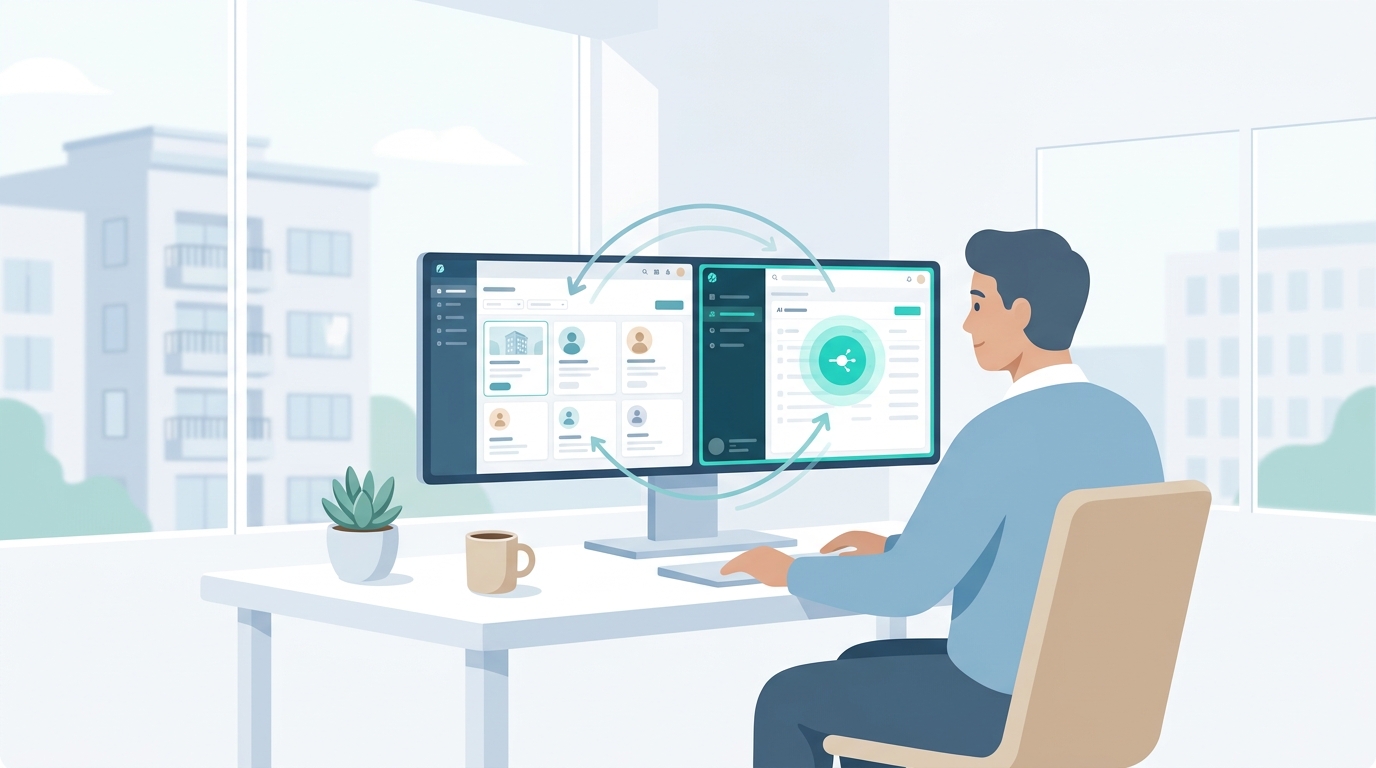
Short answer: a well-built leasing tool will not break your PMS or duplicate your records — because it syncs your properties in and runs leasing in its own system, not by writing into your ledger. The real integration risk is not corruption; it is compatibility — whether your PMS is supported at all. Here is how to test that before you sign.
Why this is the question everyone asks second
"Since our showing tool merged with the other one, we have been having some issues." That sentence — or some version of it — came up repeatedly across LetHub's discovery calls with property managers. It is not abstract anxiety. It is lived experience: a prior tool migration left behind messy data, mysterious settings changes, or records that multiplied without explanation.
The fear is legitimate. Property managers who have been burned by a bad integration carry the scar. They have seen what happens when a third-party tool touches their books and leaves fingerprints — duplicate tenant records, out-of-sync availability, or charges that do not reconcile cleanly. Syndication and API integration problems rank among the most frequently cited frustrations in the PM software space, and they tend to surface not at onboarding but six weeks later, when something stops matching.
What makes this particularly frustrating is that the problems often feel random. A record appears twice with no clear cause. A setting changes with no audit trail. A showing entry in the leasing tool does not appear in the PMS. Without a clear mental model of how the integration actually works — what talks to what, and in which direction — these problems feel like gremlins rather than fixable engineering choices.
The fear is real. But most property managers walking into a demo are afraid of the wrong thing. They are worried about data corruption. The actual deal-killer — the thing that ends more conversations than any bad data outcome — is something else entirely. This piece covers four things: how duplicate records actually happen, what the real integration risk is, what happens when a sync goes down, and the seven questions to ask any vendor before you sign.
Why do third-party integrations create duplicate records in the first place?
Duplicate records are a known, solvable engineering problem — not an inevitable feature of connecting two systems. Understanding the mechanics is exactly how you screen them out during a demo, because you will know which questions to ask and which answers are incomplete.
There are two root causes behind most integration duplication:
- Weak matching logic. A tool that matches records on exact email only will create a second record the moment it encounters a variation — a middle initial added, a typo, or a second email address on file. One record becomes two because the system has no fallback to recognize the same person across slightly different inputs. In a busy leasing operation where prospects reach out across multiple channels — a Facebook inquiry, then a follow-up from a different email — this kind of brittle matching quickly multiplies records.
- Network retries without idempotency. A create request times out before the server responds. The client retries. The server processes both, and the same record gets written twice. Without an idempotency key — a unique identifier that tells the server "you have already handled this exact request" — retries produce duplicates. This is common in any system under load or operating over an unreliable connection, which describes most cloud-to-cloud integrations at scale.
Well-built integrations solve both at the foundation: robust deduplication logic that matches on more than one field, and idempotency keys that make retries safe. Stripe's engineering documentation and mainstream data-engineering guidance both treat idempotency as a non-negotiable baseline for any system handling repeated or time-sensitive requests. It is table stakes — not a differentiator — for any integration vendor worth evaluating.
Why does the underlying data quality matter so much to property managers specifically? An industry study of multifamily property managers (CRETI, 2025, 325 respondents) found that 60% encounter financial discrepancies every month, and 40% report quarterly accounting errors. Data quality problems are not edge cases — they are a recurring operational cost. MIT Sloan estimates poor data quality costs organizations 15–25% of revenue. The matching-and-idempotency engineering underneath a leasing tool is what stands between your operation and that number.
Knowing how duplicates happen gives you a specific question to ask in every demo: how does this system match records, and what happens when a request times out? If the vendor cannot explain their retry handling in plain terms, that is a useful signal before you are live.
What is the real integration risk — corruption, or compatibility?
Here is the finding that surprised us most across LetHub's 112 discovery calls with property managers: when integrations actually kill a deal, the cause is almost never data corruption. It is compatibility.
"You guys do not integrate with our PMS, so I do not even know if that is a possibility." That sentence is a deal-ender — and it ends the conversation before a single feature is ever discussed. "The integration piece would be a deal breaker," said another PM, flatly, when their system turned out to be unsupported. These conversations did not fail because someone's records got corrupted. They failed because the tool simply did not speak the language of the PM's existing system.
This reframes the question worth asking. The corruption fear — will this tool write something bad into my books? — is largely addressed by architecture. If a tool syncs your properties, listings, and availability in and runs leasing inside its own system, it is not writing to your PMS ledger. It cannot overwrite or duplicate your books because it is not touching them. The leasing activity lives in the tool's system; your accounting lives in your PMS. They stay separate by design, which means the corruption scenario most PMs fear is structurally prevented before any data-quality engineering even enters the picture.
LetHub syncs your properties and pulls listings and availability from the major PMSs — AppFolio, Buildium, RentVine, Propertyware, Rent Manager — and runs leasing in LetHub. For Canadian property managers running Yardi for accounting, the pattern holds: Yardi handles the books, LetHub runs leasing. That is not a Yardi sync; it is a division of responsibility that keeps each system doing what it does best, without either one reaching into the other's territory.
The compatibility question, then, is the right one to lead with: does this tool support my PMS, and what exactly does it sync?
[[cta]]What happens to my leasing if the sync goes down or my PMS has an outage?
This is a different question from duplication — it is the blast-radius question. If the connection between your leasing tool and your PMS drops, what stops working, and what keeps going?
A well-architected answer looks like this: because leasing runs in the tool's own system, a sync hiccup or a PMS outage should not stop leasing operations. Inquiries still get answered. Showings still get booked. The sync catches up when the connection returns. What is temporarily out of sync is the ledger view — accounting, payment records, the things that live natively in your PMS. But the activity that loses you leases — slow or missed inquiry response — should keep running regardless of what is happening on the PMS side.
The mental model worth holding: there are two systems with different failure modes. Your PMS holds your accounting and your ledger. Your leasing tool holds your lead pipeline and your showing calendar. A sync interruption between them affects one; the other keeps running. A tool that cannot operate independently of a live PMS connection is a tool with a single point of failure, and that is exactly the kind of architectural question to raise before you commit to a contract.
The cost of an outage compounds fast when it forces manual reconciliation. Parseur and QuestionPro (2025) estimate that manual data re-entry costs organizations approximately $28,500 per employee per year at a 1–4% error rate. Even a brief sync outage that triggers a round of manual catch-up erodes the efficiency gains you brought a leasing tool in to create.
The better question is not "will the sync ever go down?" — it will, eventually, as any cloud service will — but "when it does, how much of my operation actually stops?" A vendor that can answer this specifically, with a real explanation of how their architecture handles sync failures, has thought through the failure mode. One that deflects to uptime percentages without addressing the blast-radius question has not.
You cannot know any of this from a feature page. You have to ask.
What should I ask a vendor about reliability before I sign?
These seven questions are portable — use them in any demo, with any vendor. A vendor that answers crisply has built the reliability in. One that deflects or hand-waves almost certainly has not, and you will find that out at the worst possible time.
- What do you write into my PMS versus only read from it? A read-only sync cannot corrupt your books. Know the direction before anything else — it determines how much your PMS is actually at risk.
- How do you match records — and what stops duplicates? Listen for logic that goes beyond exact-email matching. Ask specifically about what happens when the same person reaches out with two different email addresses or a slight name variation.
- What happens to a request that times out — do you retry safely? The right answer involves idempotency keys. An answer of "we retry automatically" without mentioning idempotency is a yellow flag — automatic retries without idempotency keys are how duplicate records get written.
- If the sync or my PMS goes down, does leasing keep running? Ask them to explain the blast radius in concrete terms. What specifically stops, and what keeps working? A tool that requires a live PMS connection to answer an inquiry has a design problem worth understanding upfront.
- What is your uptime, and is there a status page? Any vendor that has built for reliability has a status page and a real number. The absence of an answer here is informative on its own — ask where you would go to check status during an incident.
- What is your support response time when a sync breaks? "Settings change mysteriously" is the lived experience of slow support response after an outage. Get a concrete service level agreement before you need it — not after the sync breaks at 10pm on a Saturday.
- Which PMSs do you actually support — and how does the sync with AppFolio, Buildium, or RentVine work? Compatibility is the real risk. Get the supported-PMS list in writing, and ask them to describe specifically what they sync and what they do not. "We work with AppFolio" and "we sync your AppFolio properties and listings" are different claims.
How do I test integration reliability during a demo, not after I am live?
The checklist above only works if you use it before signing. Most property managers find out how reliable an integration is after they are live — which is exactly the wrong order.
Ask them to sync your real properties in the demo session itself. Not a test environment, not a sandbox account with sample data — your actual listings, pulled from your PMS, in real time. Watch what comes through, what gets missed, and how long the pull takes. If the demo always uses clean sample data, that is worth noting — it may mean the live sync behaves differently from what you are being shown.
Ask what a failed or timed-out sync looks like from your side. Do you get an alert? An error log? A notification in the tool? Or does it fail silently and leave you to discover the discrepancy when a prospect shows up for a showing that was not correctly booked? The failure mode matters as much as the happy path, and a vendor that has designed a good failure experience will be able to show it to you.
Ask for the supported-PMS list in writing before the end of the call. Then have them walk the read-vs-write boundary on screen: specifically, show me what your tool reads from my PMS and what, if anything, it writes back. That single question surfaces more about the actual integration architecture than most feature-page copy ever will. The answer tells you both how the sync works and whether the vendor understands their own product clearly enough to explain it.
The goal is to leave the demo knowing exactly what touches your PMS, what stays in the tool's own system, and what happens when the connection between them breaks. For a deeper look at how sync depth works — one-way versus two-way, and what capability tests to run in a live demo — see our companion piece on how deep the sync actually goes.
[[cta2]]Frequently Asked Questions
Will connecting an AI leasing tool break my PMS or create duplicate records?
No — if the tool syncs your properties in and runs leasing in its own system, it is not writing to your PMS ledger, so it cannot overwrite or duplicate your books. Leasing results sync back to most major property management software; your accounting stays untouched.
Why do third-party integrations create duplicate records?
Two usual causes: weak matching logic — for example, matching on exact email only, so a small variation creates a second record — and network retries that write a timed-out request twice. Both are solved by idempotency keys and robust deduplication, which any well-built integration includes as a baseline.
Is it safe to connect AI leasing software to AppFolio, Buildium, or RentVine?
Yes, when the tool syncs your properties and listings from them rather than writing into your ledger. Ask the vendor exactly what it reads versus what it writes — and whether its sync with each specific PMS is one-way or two-way.
What happens to my leasing if the integration goes down?
With leasing running in the tool's own system, inquiries and showings should keep going and the sync catches up when the connection returns. Ask any vendor to confirm explicitly how their tool behaves during a sync interruption — it is a design decision, not a given.
How does a leasing tool sync with my PMS without overwriting my data?
By pulling your properties, listings, and availability in, running leasing on its side, and syncing leasing results back to most major property management software — never into your accounting ledger. Your books cannot be overwritten or duplicated because nothing writes to them.
What is the real risk of a PMS integration?
Usually compatibility — whether your PMS is supported at all — not corruption. Across LetHub's discovery conversations with property managers, deals ended on "you do not support my system" far more often than on any data-quality incident.
What should I ask a vendor about integration reliability before signing?
Start with the seven questions above — particularly "what do you write versus only read," "what stops duplicates," and "which PMSs do you actually support." A vendor with clear, specific answers to all seven has built the reliability in; one that deflects has not.
How do I test integration reliability during a demo?
Have them sync your real properties live in the session, show you what a failed sync looks like and how you would know, and walk the read-vs-write boundary on screen — do not wait until you are live to discover any of this.
See exactly what LetHub syncs from your PMS — and what it never touches — in a 20-minute demo. Book a demo →
Leasing Automation Report
See LetHub on your own PMS and listings