Short answer: Self-showings let a scattered-site manager make a vacant home tourable on-demand instead of driving out to unlock it — a verified renter tours the house alone, on their own schedule, no staff truck or afternoon required. For a portfolio spread across a metro instead of stacked in one building, that removes leasing's single biggest hidden cost: the drive.
Picture a Tuesday: a 9 a.m. showing in one subdivision, an 11 a.m. twenty-two minutes away, a third that afternoon back across town because the renter could only make 3 p.m. Three houses. Three trips. By the time that last showing wraps, none of those three vacant homes gets shown again today — the drive between them ate the hours a single leasing agent actually had free to show anything.
Why Is Drive Time the Hidden Tax on a Scattered-Site Lease-Up?
A multifamily leasing office shows twenty units without moving a car. A scattered-site portfolio doesn't get that luxury — every vacant home is its own address, often ten, twenty, forty minutes from the last one. There are roughly 14.3 million single-family renter households in the US, about a third of all renters, and by design they sit scattered across suburbs and neighborhoods rather than stacked in one building (Joint Center for Housing Studies at Harvard University, 2023, citing 2021 data). That dispersion is the whole business model — and the whole logistics problem.
Every one of those homes needs a person physically present to let a renter in, unless something else does that job. The IRS puts a number on what "physically present" costs: as of mid-2026, the federal business mileage rate sits at 76 cents per mile, up from 72.5 cents earlier in the year (IRS, Standard Mileage Rates, 2026). Drive a scattered portfolio's worth of showings every week and that per-mile figure stops being trivia and starts being a line item nobody budgeted for.
What Does That Drive Actually Cost Per Showing?
Run the vehicle math on one round trip and the number is small on its own — which is exactly how it hides. At the current IRS rate, a 20-mile round trip to a single showing costs about $15 in gas, wear, and depreciation before anyone's even inside the house:
| Round-trip distance | Vehicle cost alone (IRS 2026 rate, $0.76/mile) |
|---|---|
| 10 miles | $7.60 |
| 20 miles | $15.20 |
| 40 miles | $30.40 |
Multiply that by every accompanied showing a scattered-site team drives to in a week, and the vehicle cost turns out to be the smaller half of the bill. The bigger half is the hour-plus that person isn't touring anyone else, answering another lead, or doing anything that would keep a different vacant home from sitting empty one more day.
Does Batching Showings Into Routes Actually Fix It?
The obvious mitigation is batching: group three or four showings on nearby streets into one route, one afternoon, one tank of gas. It helps — a batched route spreads the drive across several appointments instead of paying it out one trip at a time.
It doesn't fix the constraint underneath it. Batching only works when several renters can show up in the same window on the same day — the renter who can only do 6 p.m. Thursday doesn't fit a route built around one driver's calendar. A no-show inside a batched stop still burns the trip, just a smaller share of it. A company leasing across three counties can't route its way out of County A and County C sitting forty minutes apart.
Batching is a scheduling patch on top of a model that still requires a person to travel. It reduces the tax. It doesn't repeal it.
How Do Self-Showings Remove the Drive Entirely?
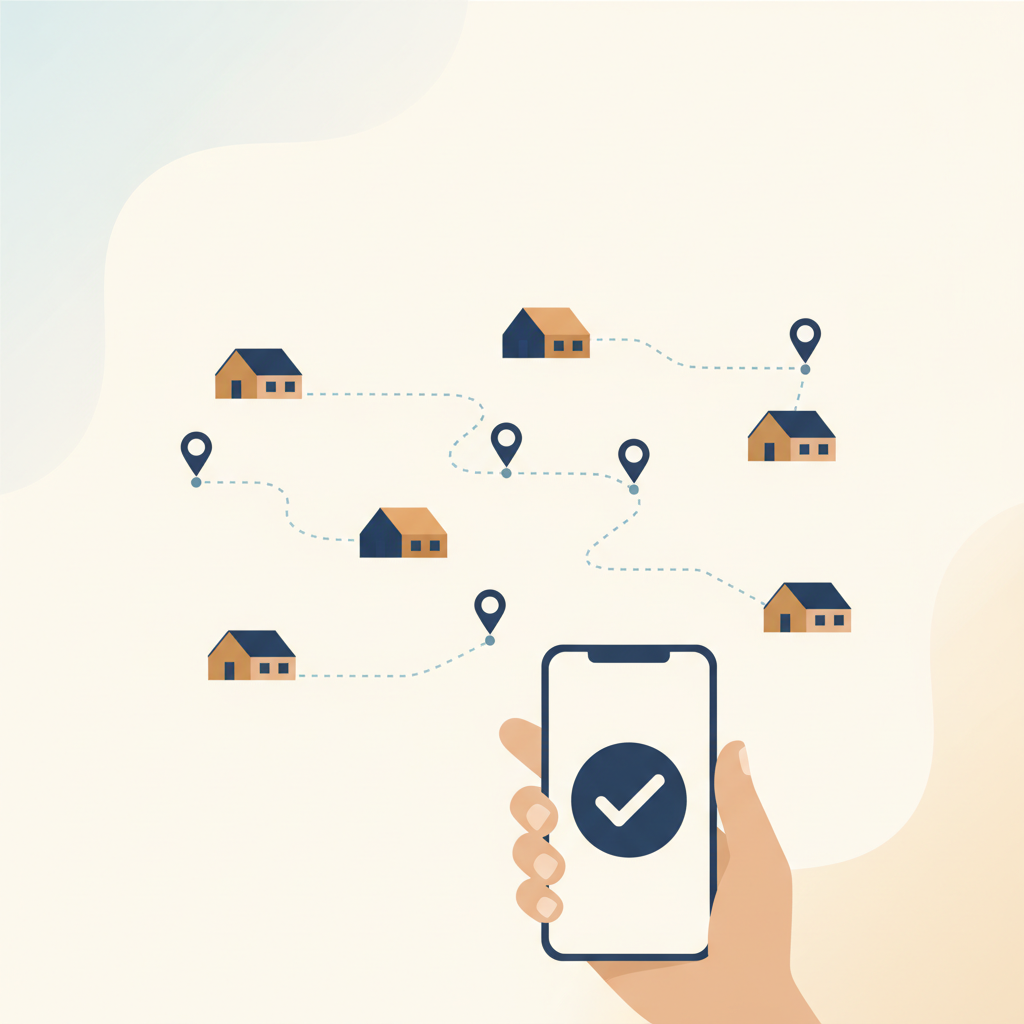
On-demand access changes the constraint itself: instead of routing a person to the door, a verified renter opens it themselves, whenever their schedule allows, with nobody driving anywhere. It's the same two phrases that come up on almost every scattered-site discovery call — self-touring, distance between homes — because the operators feeling this tax hardest are the ones with doors spread across a metro instead of stacked in one leasing office.
Self-showings work by gating access instead of staffing it: a renter verifies identity — a government-ID scan matched to a live selfie — before a door code releases, and that code only works inside a confirmed window. The part that matters most for scattered-site portfolios is that this doesn't require retrofitting every property with matching smart-lock hardware. A smart lockbox makes single-use, auto-expiring codes simple where one's installed, but an ordinary offline lock with a static code runs the same verify-first sequence — the security lives in the ID check, not the metal on the door. For a portfolio built one acquisition at a time, with a different lock brand behind every door, that's the difference between a rollout and a renovation.
Why Does After-Hours Coverage Compound the Savings?
The math improves further once the same access model covers evenings and weekends, because that's exactly when a scattered-site team was never going to drive out anyway — nobody was routing a solo 7 p.m. trip to unlock one house for one renter, so those hours simply went unshown. Take the drive out of the equation and there's no longer a reason that hour was off-limits.
There's a real dollar clock on every one of those extra vacant days: the median asking rent on a vacant U.S. rental was $1,531 a month in Q2 2026 (U.S. Census Bureau, Housing Vacancy Survey) — call it roughly $50 a day sitting on the table while a home stays empty. And the average American commute already runs 27.2 minutes each way in 2024, up from 26.8 in 2023 (American Community Survey). A manager driving to four scattered showings a day runs that trip four times over, to houses that aren't paying them to be there. Remove the drive and the time goes straight back to filling the next vacancy.
What Should a Scattered-Site PM Set Up First?
Start with the doors that already sit vacant longest — usually the ones furthest from your last showing, in whichever subdivision has too few other units to batch with. Those are losing the most to drive time today, and they're the ones an on-demand, ID-verified showing helps fastest. Confirm identity verification and a time-boxed access window are ready before the first code goes out, whether the door carries a smart lockbox or an ordinary lock — the sequence matters more than the hardware behind it.
LetHub runs that sequence automatically across a scattered portfolio: a renter's call, text, or chat gets answered in about 30 seconds, a self-showing gets booked, a bank-level ID check clears them, and they let themselves in — no truck, no route, no one driving to a house that isn't theirs. See it running on a real scattered-site portfolio — book a demo.
Frequently Asked Questions
What is a self-showing for a single-family rental?
A self-showing lets a prospective renter tour a vacant single-family home without a leasing agent present. The renter verifies identity first — a government-ID scan matched to a live selfie — then gets time-boxed access, through either a smart lockbox or an ordinary offline lock, and tours the house alone.
How much does driving between showings cost a scattered-site manager?
Vehicle cost alone runs at the IRS's standard mileage rate — 76 cents per mile as of mid-2026 — so a 20-mile round trip costs roughly $15 in gas, wear, and depreciation. The larger cost is time: every hour driving between scattered addresses is an hour not spent filling a different vacancy.
Does self-showing work without a smart lockbox on every door?
Yes. Identity verification and a time-boxed access window work the same on an ordinary offline lock with a static code as on a smart lockbox — the security lives in confirming who's requesting access, not the hardware. That matters where every door was installed by a different previous owner.
Can self-showings cover evenings and weekends without extra staff driving out?
Yes — that's the other half of the savings. Once access doesn't require someone physically present, there's no staffing call to make about a 7 p.m. or Saturday showing; verified, time-boxed access works whenever the renter is actually free, with nobody driving out after hours to open a door.