A no-show isn't one empty calendar slot — it's roughly two hours of paid agent time and fuel burned driving to a property nobody showed up to. Rental no-show rates run around 20–22%. The biggest levers, in order: remove the drive for low-intent tours with self-guided, ID-verified showings; pre-qualify before booking; respond in seconds; and use reminders as the floor, not the ceiling.
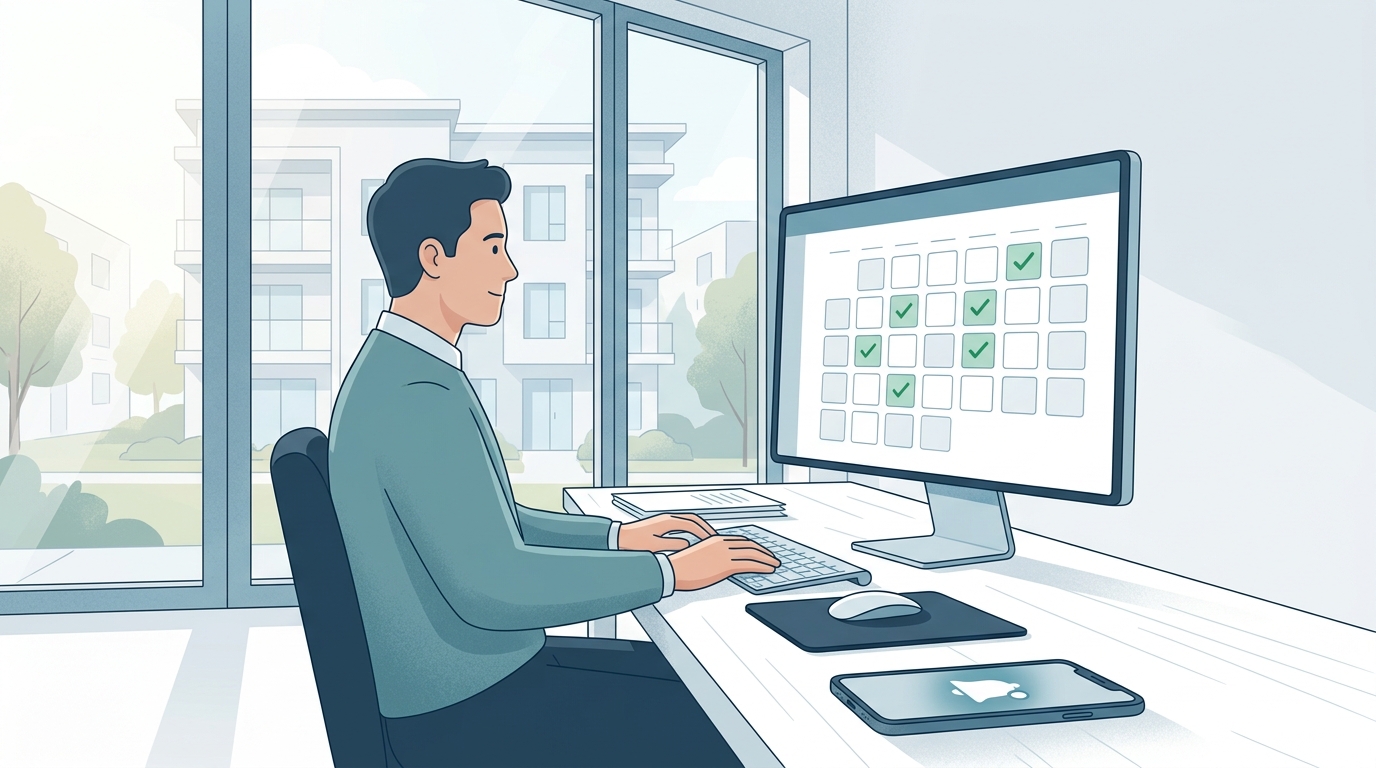
An agent climbs into a truck, drives 45 minutes out to a property, and sits in an empty driveway. Nobody shows. Nobody texts. The agent drives 45 minutes back, having burned a half-morning and a quarter tank of gas on a lead who booked on a whim and moved on before the tour date arrived.
That scene plays out constantly across scattered single-family portfolios. One operator told us: "From the top of our county to the bottom is about 70 miles — sometimes it's worthless, we get there and they don't show up." Another, a single-family manager with a similar footprint, put it plainly: "Some of them are 45 minutes away from our agent's houses, and they're driving all the way there, just sit there."
The piece that most "reduce no-shows" advice misses entirely is that the cost isn't the empty appointment slot — it's the windshield time. The drive out. The drive back. The leads left unworked while your agent was on the road. Most guidance stops at "send a reminder text." That's the floor, not the strategy. This post covers the full ladder of levers, ordered by actual leverage, with real numbers behind each one.
Why Do Rental Showing No-Shows Cost More Than They Look?
A no-show is not a missed appointment. It's roughly two hours of paid agent time plus fuel, plus every other lead left unworked while that agent was on the road and unavailable for anything else.
The math compounds fast in scattered single-family portfolios. A 30–70 minute drive each way — the range property managers described repeatedly across our 112 discovery calls — means a single truly wasted showing run eats a half-day. Unlike apartment complexes where a leasing agent is already on-site and a no-show is just 20 idle minutes, single-family means one prospect per slot and a long commute in each direction. The drive is the cost. The empty slot is almost secondary.
Layer on top of that the vacancy clock. A unit sitting empty costs roughly $33–60 per day in lost rent alone — about $33/day on a $1,000/month unit, $50–60/day on a $1,500–1,800/month unit — before you count mortgage, taxes, insurance, or utilities. Every no-show that delays a lease-up by even a couple of days adds those days to the vacancy tally. On a $1,500/month unit, one wasted week from a string of no-shows costs $350 in lost rent before you've factored in anything else.
Property managers who calculate their no-show cost in "missed appointments" consistently undercount it. The actual calculation is: agent hourly rate × 2+ hours + fuel + opportunity cost of unworked leads + pro-rated vacancy per delayed day. The empty slot is the cheap part. The windshield time and the slow-to-fill unit are what add up.
What's the Real No-Show Rate for Rental Showings?
Roughly 20–22% of scheduled rental tours don't happen. Present that as a range — the exact number shifts by market, portfolio type, and how bookings are handled. A property manager using instant online booking with no friction will see a different rate than one who schedules by phone after a brief qualifying conversation.
| Source | No-Show Rate | Context |
|---|---|---|
| Self-guided tour platforms (industry, 2025–26) | ~22% | Scheduled self-guided tours that don't happen — consistent with the 20–22% range across tracked platforms |
One number to treat carefully: a "40% no-show rate" circulates widely in property management discussions, sometimes cited as a baseline for what you're working against. It has no traceable primary source — no survey, no sample size, no methodology behind it. The 20–22% range has documented backing and is the more defensible estimate to plan around. If your portfolio is seeing rates significantly above that range, something structural is working against you — usually a combination of no pre-qualification and delayed first response.
Why Do Prospects No-Show in the First Place?
Most no-shows aren't flaky people. They're low-commitment bookings — prospects who had no skin in the game when they scheduled, or who found another place before the tour date arrived and didn't bother to cancel. Understanding which type of no-show you're seeing changes which fix applies.
The common causes, based on what property managers described across our discovery calls:
- They booked several showings and picked the most responsive landlord. A prospect who inquired on four properties the same afternoon is going to the one that replied fastest and felt most organized. If yours went quiet for a few hours between booking and tour day, it drops off the shortlist.
- Tire-kickers and not-yet-serious renters. Someone browsing with no real move-in urgency — they're thinking about moving in four months, or they're window-shopping between lease renewals. They scheduled because it was easy, not because they were genuinely committed to the appointment.
- They found a place elsewhere. The rental market moves fast. Between the day they booked and the day of the tour, they toured somewhere else, liked it, and signed. They didn't cancel your tour because they forgot, or because they felt no obligation to.
- Casual lookers or scammers on self-tour bookings. For lockbox properties, some bookings come from people who are curious about the layout, not genuinely in the rental market. No identity check at booking means no barrier to scheduling.
- No friction at booking meant no commitment. A showing that took 30 seconds to schedule, required nothing from the prospect, and carried no confirmation of intent is easy to abandon without guilt. Low friction at booking and low commitment at the tour go together.
Each of these points to a different lever. The fix for a tire-kicker is pre-qualification. The fix for a response-speed no-show is faster first contact. The fix for a casual self-tour no-show is ID verification. Reminders help across the board, but only with the subset who would have shown if they'd been reminded.
[[cta]]
Do Reminder Texts Actually Reduce No-Shows?
Yes, measurably — but reminders are the floor of your no-show strategy, not the ceiling. Around 98% of text messages get opened, which means a confirmation or reminder reliably lands in front of the prospect. It's the cheapest lever you have, and it handles a real category of no-show: the prospect who genuinely forgot, or who would have cancelled if they'd had a convenient way to do it.
A pilot study from the University of Kentucky (Stephenson, UKnowledge, 2016) confirmed that text-based reminders meaningfully reduce missed appointments in service contexts — the same mechanism applies to rental showings. Getting the message in front of someone 24 hours and 1 hour before a commitment consistently nudges behavior.
The practical setup that works:
- Confirm at booking — immediately, not two hours later. A same-day confirmation lands while the prospect still remembers making the appointment.
- Send a reminder 24 hours before the showing. This catches the prospect while there's still time to cancel or reschedule rather than just not showing.
- Send a second reminder roughly one hour before. Short, no fluff — just the address, the time, and a reply-to-cancel option.
- Make it two-way: let the prospect reply to cancel. A cancellation beats a no-show every time — it frees the slot before your agent gets in the truck, and it costs you nothing.
Where reminders reach their ceiling: they do nothing for the prospect who found a place three days ago, or the one who was never serious enough to show regardless of how many times they were reminded. If reminders are the only tool you're running, you're handling one out of five no-show types and leaving the rest unaddressed.
Does Pre-Qualifying or Requiring ID Before a Showing Cut No-Shows?
Pre-qualifying before a live tour is one of the highest-leverage no-show fixes available. Requiring ID for self-tours is a security and serious-intent filter — useful, but for a slightly different reason than most people assume.
These are two distinct moves, and they're worth keeping separate:
Pre-qualify before a live agent tour. Ask budget, move-in date, and unit must-haves before you confirm a showing appointment. A prospect who won't answer three questions isn't ready for a live tour. The small amount of friction this adds is intentional — it separates serious renters from casual browsers. Every prospect you filter out here is a drive your agent doesn't make. For a single-family PM with 45-minute commutes between properties, even filtering out one unqualified prospect per week adds up to hours of recovered time over a month.
ID-verify before a self-tour. Requiring bank-level ID verification before issuing a lockbox code protects the property and filters out prospects who aren't serious enough to complete a brief verification step. It's primarily a security play — protecting the unit from scammers and casual lookers — rather than a proven no-show-rate reducer in itself. A 2026 Payscore study found that pre-tour ID verification had no measurable impact on application-stage fraud ("Everything You Know About Tenant Screening Is Wrong," Payscore, 2026). Position it honestly: it's about protecting the lockbox and creating a commitment signal, not about shifting the aggregate no-show percentage.
Tied back to the moat: the combined effect of pre-qualification plus ID-verification is that the only prospects reaching your properties are ones who've already made two small commitments — answering qualifying questions and verifying their identity. That self-selected pool is materially more likely to show up.
How Does Responding Faster Reduce No-Shows? (The Speed-to-Lead Link)
A prospect who waits hours for a reply has already booked two or three other showings. When tour day comes, yours is the one they skip — either because they've already signed somewhere else, or because the landlord who responded in two minutes felt more responsive and better organized. Slower response produces a cooler, less committed booking from the very start.
Property managers told us this directly across discovery calls: leads land in a shared inbox and sit. "By the time the team picks it up, maybe it's two hours later, maybe the next day." By then, the prospect has moved on. The booking you eventually confirm is with someone who's already mentally half-checked out of the process.
The research on response speed is instructive, though it measures qualification rate rather than no-show rate directly: firms that responded to online leads within an hour were roughly 7x more likely to have a meaningful conversation with that lead (Harvard Business Review, "The Short Life of Online Sales Leads," 2011). A landmark 2007 MIT/InsideSales study found the odds of qualifying a lead drop by 21x when response time slips from 5 minutes to 30 minutes (Lead Response Management Study, Oldroyd et al., 2007). The mechanism transfers directly: a faster first response means a warmer, more engaged prospect at booking — and a warmer, more engaged booking is one that survives to the actual tour.
The practical setup: respond in seconds, not hours. Book the showing while the prospect is still actively looking at the listing. Confirm the appointment on the spot, in the same exchange. A booking made during a live, engaged conversation is far less likely to evaporate than one where you sent a message, waited three hours, got a reply, waited again, and finally confirmed the next morning.
Do Self-Guided Showings Have Fewer No-Shows Than Agent-Led Tours?
For low-intent tours, self-guided showings change the no-show equation fundamentally — if a prospect doesn't show, no agent drove 45 minutes for nothing. The no-show rate doesn't necessarily drop, but the cost of each one collapses to near zero.
This is the structural reframe that most no-show guides don't reach. The property managers with the worst no-show pain in our conversations were the ones still running agent-led showings across scattered single-family portfolios — long drives, one prospect per slot, an agent tied up for two hours whether the prospect showed or not. The advice they received was to "remind more" or "pre-qualify better." Both help. But the actual structural fix was to remove the agent's drive for low-intent tours entirely.
Self-tours still get no-shows. Someone who books a self-guided showing and doesn't show has still wasted a slot on your calendar. The difference is that a no-show at a lockbox property costs almost nothing compared to a no-show at the end of a 45-minute drive. The pain isn't eliminated, but it shrinks from half a day of wasted time to a couple of minutes of resetting a code.
The right design: pair self-tours with ID verification (security and intent filter, per the earlier section) and reserve live agent-guided tours for prospects who've already pre-qualified. That's when an agent's time is genuinely worth spending — on someone who cleared your criteria, verified their identity, and chose your property over alternatives. Everything below that bar goes through a self-tour first.
How Do You Build a Leasing Process That Minimizes No-Shows?
Stack the levers in order of leverage, not alphabetically or by ease of setup. The right sequence moves from structural fixes — the ones that change the cost of a no-show or prevent low-commitment bookings — down to tactical tools like reminders that improve outcomes within an existing process.
- Remove the drive for low-intent tours. Self-guided, ID-verified showings mean a no-show costs almost nothing in agent time. This is the structural fix, not an add-on. Build it first.
- Pre-qualify before a live agent tour. Budget, timeline, and unit requirements. Filter out tire-kickers before you book the drive. Every unqualified prospect you screen here is agent time and fuel recovered.
- Respond in seconds, not hours. Keep the booking warm from the first inquiry. A fast first response produces a more engaged, more committed prospect before the tour date even arrives.
- Confirm and remind (the floor). Two-way texts at 24 hours and 1 hour out, so a cancellation frees the slot before the drive happens. This is table stakes, not strategy — run it alongside everything above.
These four levers address different no-show types. Running all four means you're covering the structural drivers (low-intent bookings, slow response), the commitment gap (no pre-qualification), and the reminder gap simultaneously. Running only the last one leaves most of the problem untouched.
This is how LetHub handles all four automatically: a sub-30-second AI response keeps bookings warm from the first inquiry; bank-level ID-verified self-guided showings remove the agent drive for low-intent tours while filtering scammers; built-in pre-qualification questions gate access to live appointment slots; and syncs with all major PMSs — including Buildium, DoorLoop, RentVine, and AppFolio — so bookings flow without anyone re-keying data by hand. Works for residential portfolios across the US and Canada.
[[cta2]]
FAQ
What is a normal no-show rate for rental showings?
Roughly 20–22% of scheduled tours don't happen — treat that as a range, not a hard number, since it shifts by market, portfolio type, and how your booking process is structured.
What does a rental showing no-show actually cost?
The expensive part isn't the empty slot — it's roughly two hours of paid agent time and fuel for the drive, plus the leads left unworked during that time, on top of another $33–60/day in vacancy cost on a mid-range unit.
Do reminder texts reduce no-shows?
Yes, measurably — texts hit around 98% open rates, so a confirmation and reminder reliably reaches the prospect. It's the floor of your strategy, not the ceiling, and it handles only one type of no-show (the one who forgot).
Does requiring ID stop no-shows?
ID verification is a security and serious-intent filter for self-tours, not a proven no-show-rate reducer on its own. A 2026 Payscore study found no measurable impact on application-stage fraud from pre-tour ID checks — so position it as protecting your lockbox and screening casual lookers, not as a direct no-show fix.
How fast should I respond to a rental inquiry?
In seconds to minutes. Harvard Business Review research found firms responding within an hour were 7x more likely to qualify a lead; a separate 2007 MIT/InsideSales study found qualification odds drop 21x between a 5-minute and 30-minute response. A faster, warmer booking is a more committed booking that's more likely to show.
Are self-guided showings better than agent-led tours for no-shows?
For low-intent tours, yes — not because they produce fewer no-shows, but because a no-show costs almost nothing when no one drove 45 minutes to get there. Reserve agent-led tours for pre-qualified, serious prospects where the agent's time is worth spending.
Should I pre-qualify before booking a showing?
Yes, for live agent tours. Budget, move-in date, and must-haves filter out tire-kickers before you book the drive — every unqualified prospect you screen is agent time and windshield time recovered.
Can software reduce showing no-shows?
It can run all four levers automatically: instant response that keeps bookings warm from the first message, ID-verified self-tours that remove the agent drive for low-intent prospects, pre-qualification questions before a live slot is confirmed, and automated two-way reminders that let prospects cancel before anyone hits the road.
The empty driveway was never the expensive part. The 45-minute drive to get there was. Remove the drive for low-intent tours, warm the booking with a fast response, and filter before you schedule — the no-show rate follows.
Leasing Automation Report
See LetHub on your own PMS and listings