If you own single-family or scattered-site rentals, demand three things from whoever leases them: every inquiry answered in seconds, 24/7 — including by voice — ID-verified self-showings so a prospect can tour a distant home without an agent driving there, and safety that does not mean shutting self-showings off entirely. You eat the vacancy when a unit sits. The leasing tech is what protects you.
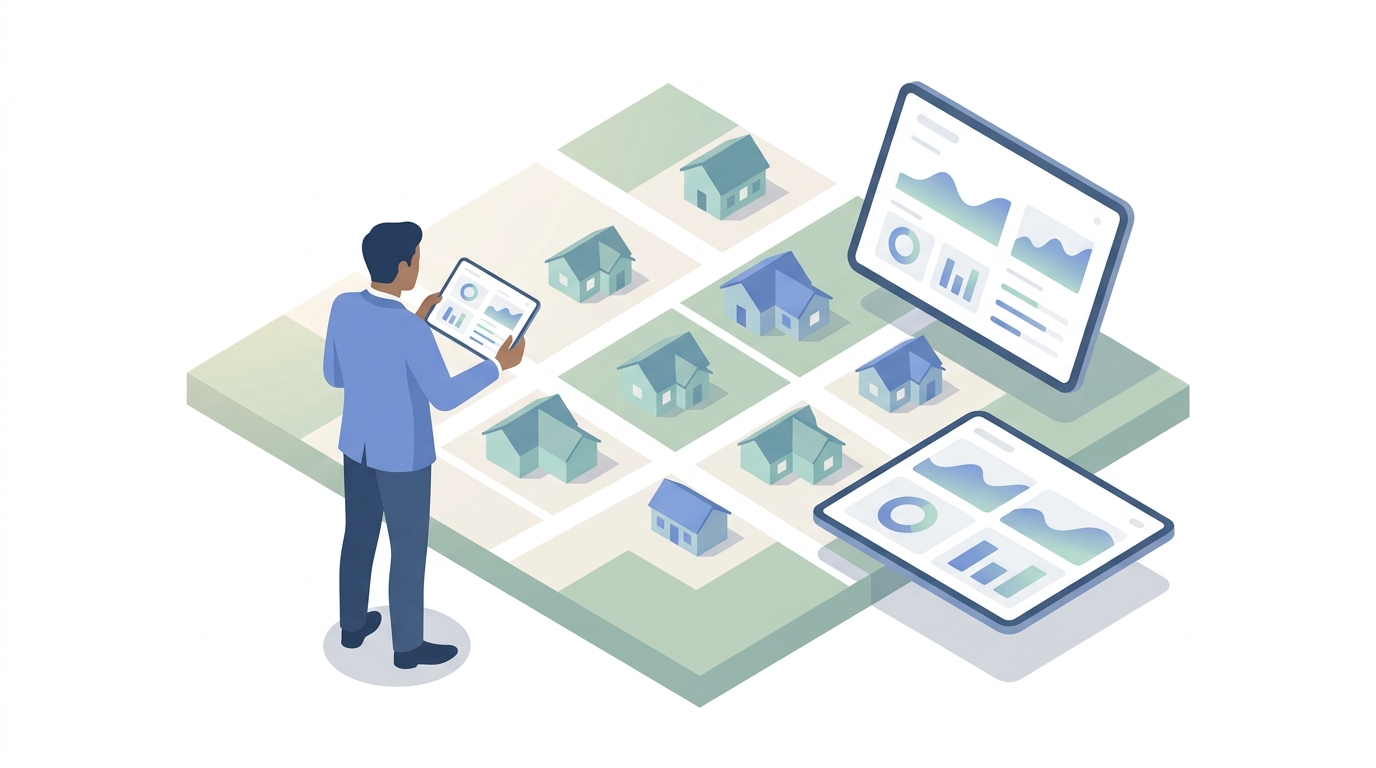
Your units are not in one building. They are spread across neighborhoods, suburbs, sometimes across an entire county. The playbook that leases a 200-unit apartment complex — one address, one on-site team, one tour route — does not map onto homes that are 40 minutes apart. That is a structural problem, not a staffing one.
It is also a bigger problem than it looks. Individual investors own 59.6% of all single-unit rentals in the United States (U.S. Census Bureau, Rental Housing Finance Survey 2024), and small mom-and-pop landlords with one or two units own two-thirds (66%) of all small rental properties (Harvard Joint Center for Housing Studies, tabulations of Census RHFS). The portfolios are small and geographically dispersed — only about 34% of single-family rental stock sits in central cities (Urban Institute). The rest is scattered across suburbs and outlying neighborhoods. That dispersion is the whole problem. And at roughly $2,225 average monthly rent for a single-family home (Zillow ZORI, single-family series) — about $74 per vacant day — you, not your property manager, carry every missed inquiry.
Why is leasing scattered-site SFR harder than leasing an apartment building?
The short answer: dispersion breaks the apartment-leasing playbook. There is no on-site team, no single tour route, and no shared inbox anyone actually owns when units are miles apart.
Three structural breaks make scattered-site SFR different:
- No on-site presence. An apartment building has a leasing office. Each of your homes has an empty driveway.
- Every showing is a separate drive. Touring one unit means a round-trip. Touring three units in a day means three round-trips — possibly to opposite ends of a county.
- Inquiries land in a shared inbox with no clear owner. When a prospect texts or calls about a specific home, the message often sits until someone on the team notices it — which can be hours later, or the next morning.
| Apartment building | Scattered-site SFR | |
|---|---|---|
| Location | One address, on-site leasing team | Units across neighborhoods or counties |
| Showings | Walk down the hall | A separate drive per unit |
| Inquiry handling | Central leasing office | Shared inbox, no clear owner |
| Who carries vacancy | Often the operator at scale | The individual owner — you |
Hiring another leasing agent does not fix the structural problem. It just shifts the cost of the drive-time tax from one person to another.
How do I make sure my distant units are not sitting vacant because nobody answered the inquiry?
Demand that every inquiry gets answered in seconds, 24/7 — including by voice — not parked in a shared inbox until someone notices it.
Inquiries on scattered units die in shared inboxes. Property managers are juggling multiple portfolios. When a prospect texts about a home on the north side of the county at 8 p.m. on a Tuesday, the message often waits. One PM described it clearly: "By the time the team picks it up, maybe it's two hours later, maybe it's the next day. It's just chaos." Another said simply: "Agents are not always available to answer calls, so I'm losing leads." Those lost leads are your lost rent.
The cost of that delay is not abstract. Research from the MIT/InsideSales Lead Response Management Study found that responding to a lead within 5 minutes versus 30 minutes makes it 21 times more likely to qualify (the archived study page). An apartment building has a front desk. Your scattered homes do not. Speed has to come from the technology, not a person.
What to demand: text and chat response in roughly 30 seconds on every inquiry across all your units, plus a 24/7 AI voice agent that answers the call a human missed. Not just during business hours — around the clock, so a prospect texting at 9 p.m. about a home three towns over gets a real answer before they move on to the next listing.
[[cta]]How can I stop leasing agents wasting half-days driving to no-show showings?
Demand ID-verified self-showings so a qualified prospect can tour a distant home on their own schedule — without an agent driving across the county to a maybe-no-show.
The drive-time tax is real, and property managers talk about it plainly. One PM running a county-wide single-family portfolio said: "From the top of our county to the bottom is about 70 miles. Sometimes it's worthless — we get there and they don't show up." A regional SFR manager described the same problem: "Some of them are 45 minutes away from our agent's houses, and they're driving all the way there, just to sit there." And in some portfolios, it is the owner doing it themselves — one 250-unit owner-operator described burning Sunday afternoons scheduling six 20-to-30-minute visit slots, filling their own calendar because the showing volume would not scale any other way.
This is not a staffing failure. It is structural to dispersed SFR. You cannot hire it away. When each unit is in a different neighborhood, every showing is its own logistics problem — and no-shows are a tax on every trip.
What to demand: self-showings where units sync from your PM's existing software, so any qualified prospect can self-tour any unit without an agent present. Drive time goes to zero. Showings run in parallel across multiple homes. The vacancy window shrinks because a prospect can tour Thursday evening instead of waiting for the agent's Saturday availability.
How do self-showings work safely across homes in different neighborhoods — without inviting scammers?
The answer to scammers is not turning self-showings off — it is ID verification before anyone gets access. Demand verified identity on every self-tour.
The risk is real. One operator managing over 1,100 single-family homes described what happened without it: "We had nothing but squatters, nothing but scam artists basically grabbing codes." The same operator described a worse scenario: "Somebody impersonating a prospect took our keys and started doing his own leasing service." Unguarded lockbox access is not self-showing — it is an open door.
Older showing tools put owners in a false choice: scale (unattended access, but scammers) or safety (agent-led tours, but the drive-time tax described above). That is the wrong trade-off. The right answer is a third path.
What to demand: ID-verified self-showings, where a prospect verifies who they are before they can access a unit. A real person with a verified identity gets to tour. Everyone else does not. You get the reach of self-touring — showings running across every home in your portfolio simultaneously, on the prospect's schedule — without handing lockbox codes to strangers.
What does fast inquiry response actually do for time-to-lease on a single-family rental?
Faster response means more tours booked, fewer vacant days, and less lost rent that lands on you. The chain is direct: inquiry answered in seconds → prospect self-tours same day → lease signed before they tour a competing listing. Versus: inquiry sits two hours → prospect is already touring somewhere else.
At roughly $74 per vacant day (based on ~$2,225 average single-family rent, Zillow ZORI), shaving even a week off the vacancy window is meaningful money per unit. Multiply that across a scattered portfolio of ten homes and the math adds up fast. The leasing tech is either capturing that value or leaving it on the table — and you are the one who feels the difference.
Should my property manager use AI for leasing my scattered single-family rentals?
Yes — if it clears the three criteria above. That is how you check.
The checklist to hand your PM:
- Every inquiry answered in roughly 30 seconds, 24/7, including by voice — no shared inbox, no waiting until morning.
- ID-verified self-showings across every unit — no agent drive-time, no unguarded lockbox codes.
- Units sync from the PM's existing software — so the system works across your full portfolio without a rebuild.
LetHub meets all three: roughly 30-second text and chat response, a 24/7 AI voice agent that answers calls humans miss, and ID-verified self-showings across units synced from your PM's software. If your PM is not already using something that clears this bar, it is worth asking why.
[[cta2]]FAQ
What should an investor demand from their property manager's leasing tech?
Three things: seconds-fast response 24/7 (including by voice), ID-verified self-showings across every unit, and listings that sync from the PM's existing software so the system covers your full portfolio.
Why is scattered-site SFR harder to lease than an apartment building?
There is no on-site team, every showing is a separate drive, and inquiries scatter across a shared inbox with no clear owner — because only about 34% of single-family rental stock sits in central cities (Urban Institute), the rest is spread across suburbs and outlying areas.
How fast should a rental inquiry be answered?
Within minutes at most — the MIT/InsideSales Lead Response Management Study found that responding within 5 minutes versus 30 minutes makes a lead 21 times more likely to qualify (the archived study page). On a distant unit with no front desk, that speed has to come from the technology.
Are self-showings safe for single-family rentals?
Yes, when access requires ID verification first — that stops the code-grabbing and key-theft problems that come with unguarded lockbox access, without going back to agent-led tours and their drive-time costs.
How do self-showings reduce the no-show problem for agents?
Prospects self-tour on their own schedule, so an agent never drives 40–70 minutes to a home only to find no one there — the tour happens independently, and only verified prospects get access.
Who pays when a scattered unit sits vacant?
The owner. At roughly $74 per vacant day (based on ~$2,225 average single-family rent, Zillow ZORI), every day the unit sits is real money the owner carries — the PM's fee does not shrink because the unit is empty.
Does AI leasing work if I only own a few homes?
Yes — most SFR investors own ten units or fewer (Census RHFS 2024), and modern leasing tools run across however many you have via your PM's existing software, without requiring a separate setup per unit.
Do I need my PM to integrate special software for this?
No — modern leasing tools sync your existing units and listings from the PM's software; you do not rebuild anything or switch platforms to get started.
When your units are scattered, the leasing tech is what stands between an inquiry and a vacant month — and you are the one who feels the gap. Demand the three.
Leasing Automation Report

See LetHub on your own PMS and listings