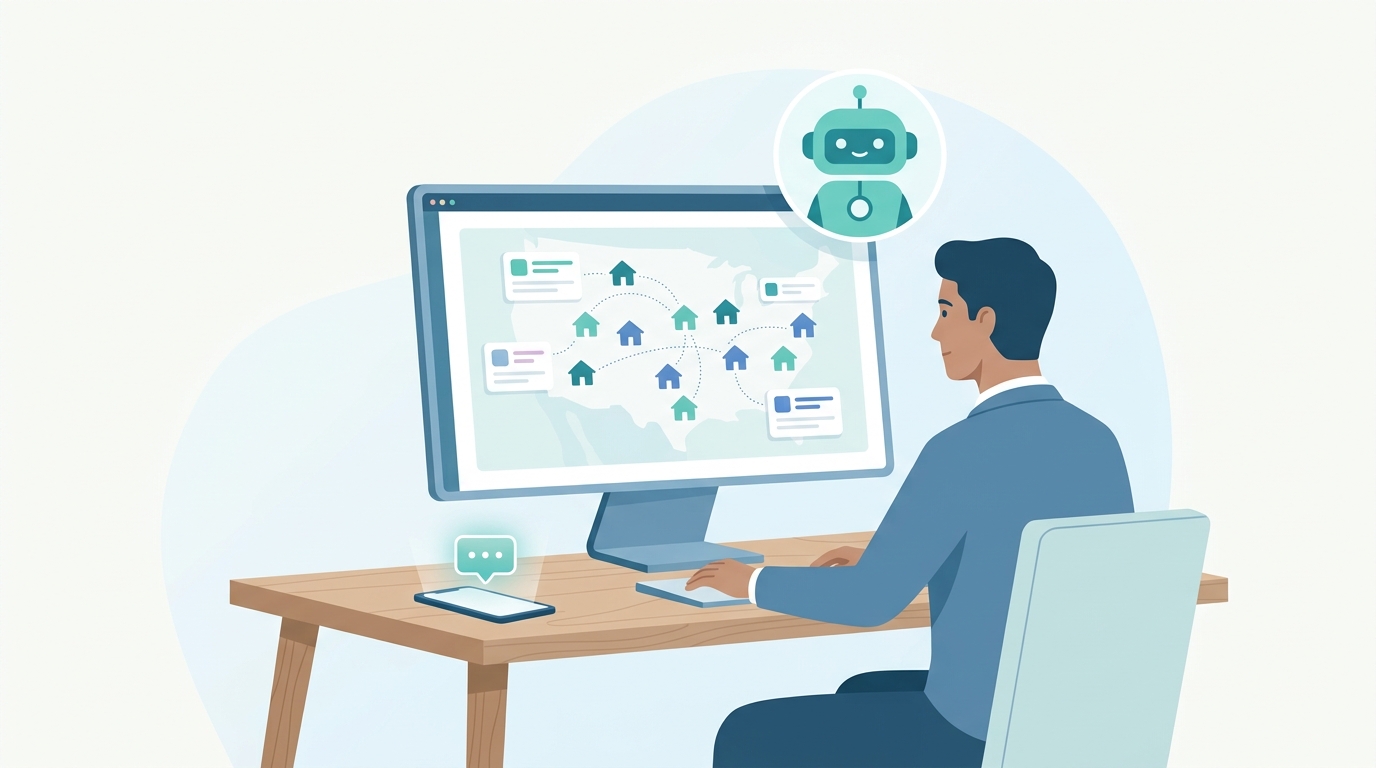
The short answer: Propertyware covers the back of the leasing funnel — online applications, AI-powered tenant screening, lead tracking, owner and tenant portals. It has no native AI to engage inbound leads. An AI leasing layer sits in front: it answers every inquiry in ~30 seconds, 24/7, qualifies the renter, books an ID-verified showing, and syncs back into Propertyware.
Propertyware handles the application. But the lease is won or lost hours before that — at the inquiry. An inquiry lands at 9pm on a house that is 40 minutes from your office. While you sleep, three more come in on three other houses across the portfolio. By the time anyone replies tomorrow, two renters have already toured somewhere else. This guide covers exactly that gap: what Propertyware does natively, where it stops, and how a front-of-funnel AI leasing layer fills the space without replacing your PMS.
Why is leasing harder for a scattered single-family (SFR) portfolio than for a single apartment building?
One apartment building has one address, one on-site team, and one tour route. A scattered SFR portfolio has dozens of homes spread across a wide service area — each one generating its own inquiries at its own hours, on its own schedule.
The scale of that market is significant. There are approximately 14.4 million single-family rental homes in the US — about one in six of all single-family homes, down from a peak near one in five — and the segment skews toward smaller operators managing dispersed properties, not centralized buildings (NAR, "Single-Family Rental Trends and Their Geography").
Geography is what breaks human-paced follow-up for this segment. In conversations with property managers across our 112 discovery calls, drive time came up repeatedly as a top-cited friction point. One manager described her situation plainly: "From the top of our county to the bottom is about 70 miles. Sometimes it's worthless — we get there and they don't show up." When your portfolio spans that kind of range, the work that fails is front-of-funnel — the inquiry response, the qualification, the tour booking — not the application or lease processing Propertyware handles so well.
What does Propertyware do natively for leasing — and where does it stop?
Propertyware's native leasing stack (as of writing) is genuinely strong at the back of the funnel. It covers online applications, AI-powered tenant screening (worth being precise here: Propertyware does use AI — in screening), lead tracking from inquiry through lease, customizable workflows, tenant and owner portals, and an open API that allows third-party integrations.
The line is clear. All of that activates once a lead is already engaged — once someone has filled out an inquiry form, or is ready to apply. Propertyware, per its own product documentation, does not include a native AI leasing assistant, conversational chatbot, or voice agent to engage inbound leads before an application exists.
That is not a criticism — it is a clear design boundary. Back-of-funnel is exactly what Propertyware is built to do, and it does it well. Applications, screening workflows, and tenant portals are the parts of leasing that benefit most from a structured, data-rich system. The open API is the hook — it is precisely what allows a front-of-funnel layer to sit in front, do the engagement and qualification work, and pass clean data back into Propertyware without duplication.
Does Propertyware have an AI leasing assistant, chatbot, or voice agent?
Not natively, no. Propertyware's AI is in tenant screening, not inbound lead engagement. The platform does not natively answer inquiries, qualify renters by text or voice, or book showings automatically — those functions are the gap a front-of-funnel AI leasing layer fills.
This is not a weakness unique to Propertyware. Most property management systems are built around what happens after a lead decides to apply. The front-of-funnel — capturing the inquiry and converting it to a qualified, booked showing — has historically required human staff. That model works at a single building with an on-site team. It breaks across a dispersed portfolio with addresses spread across a county and inquiries arriving at all hours.
[[cta]]What is "front-of-funnel" leasing, and why is it the gap for scattered SFR?
Front-of-funnel leasing is everything that happens between an inquiry and an application: answer the inquiry in seconds, 24/7; qualify the renter against your criteria; book the tour. It is the conversion layer. Propertyware picks up after this — once there is a qualified renter ready to apply.
For scattered SFR, this is where volume quietly bleeds. In conversations with SFR operators during our discovery process, a ~1,100-door Florida manager described the problem directly: "500 to 1,000 leads a month… a very small percentage is actually followed up." The follow-up gap is most severe for dispersed portfolios — more addresses, more inquiries arriving at more hours, and a human team that cannot physically cover all of them.
Scattered geography combined with after-hours inquiries and human-paced replies is a reliable formula for lost leases. The front-of-funnel layer is not a nice-to-have; for an SFR portfolio of any real size, it is the difference between capturing a renter and watching them book a tour somewhere else.
How fast do you actually have to respond to a rental inquiry?
The benchmark is clear and has been for over a decade. A Harvard Business Review study — Oldroyd, McElheran, and Elkington, "The Short Life of Online Sales Leads" (March 2011) — audited 2,241 US companies and found that contacting a lead within an hour made it approximately 7 times more likely to qualify that lead, versus waiting longer. Waiting 24 hours or more? Roughly 60 times less likely to qualify compared to that first hour. And yet the average response time in that study was 42 hours, with 23% of leads never receiving a reply at all.
Apply that directly to scattered SFR: inquiries arrive on every house, at every hour, across a portfolio that may span dozens of addresses. A human team cannot hit the first-hour window consistently across that footprint — not because they are not trying, but because the geometry does not allow it. A ~30-second automated response is not a feature at this point. It is the only way to reliably win that window at scale, across every address, every night of the week. The math is not close.
How does AI leasing sit in front of Propertyware without replacing it?
The positioning is straightforward: an AI leasing layer is the front-of-funnel that feeds Propertyware's back-of-funnel. Propertyware stays your system of record. Nothing changes about how you use it for applications, screening, leases, or portals.
The layer answers, qualifies, and books. Propertyware processes and manages. Here is how the two sides divide:
| Propertyware native (back-of-funnel) | AI leasing layer in front (front-of-funnel) |
|---|---|
| Online applications | ~30-second response to every inquiry, text/chat, 24/7 |
| AI-powered tenant screening | 24/7 AI voice agent (after-hours calls on any house get answered) |
| Lead tracking (inquiry → lease) | Bank-level ID-verified self-showings |
| Tenant/owner portals | Two-way sync back into Propertyware |
One handles the renter before they apply. The other handles everything after. The handoff is clean because neither tries to do the other's job.
What does a two-way Propertyware integration need to sync, and why does it matter for SFR?
A one-way bolt-on creates a second source of truth. That is fine for a single building where a leasing agent can manually reconcile two systems. For a scattered portfolio with dozens of addresses and constant availability changes, it breaks quickly.
A real two-way integration syncs leads and guest cards back into Propertyware, reflects live availability (so the AI front-end is not booking tours on houses that are already rented), and updates showing status so your Propertyware records stay current without manual entry. Built on Propertyware's open API, this is what separates an integrated front-of-funnel layer from a standalone tool you have to babysit.
For SFR operators specifically, availability changes frequently and unevenly across a scattered portfolio. A property gets leased in one zip code while three others across the county still have inquiries coming in. Showing statuses change. Pet restrictions vary by house. Rent amounts differ address by address. Without two-way sync, the AI front-end can confirm tours on properties that are already rented or quote terms that no longer apply — the kind of mistake that is embarrassing once and operationally corrosive at scale. Two-way sync is what keeps the front-of-funnel layer accurate rather than just fast.
How do you run self-showings across dozens of dispersed houses without inviting scammers?
The 70-mile county problem does not have a human solution at scale. You cannot send an agent to every house for every inquiry — that is the exact economics that make scattered SFR hard. But a bare lockbox code handed to an unverified stranger is a different problem: squatters, property damage, scammers listing houses they do not own.
Bank-level ID-verified self-showings resolve both at once. The renter tours the property without an agent present — solving the drive-time problem — but only after their identity is confirmed before they receive access. They get a frictionless experience. You get documentation of who toured every property, without driving across the county to be there.
For dispersed SFR, this is not a convenience feature. It is the mechanism that makes unattended showings operationally viable at scale, across properties where no on-site team exists and where drive time carries a real dollar cost every time a showing is scheduled. A verified no-show is still data — you know who the person was. An unverified no-show at a vacant property is a worse outcome with no record at all.
What should an SFR manager on Propertyware look for in an AI leasing layer?
These criteria apply to any tool you evaluate — the specifics are what matter for scattered single-family, not for a multifamily product retrofitted to fit.
- Speed: sub-minute response, 24/7, on every inquiry across every address. The HBR first-hour window is the standard to beat.
- Voice: a real 24/7 AI voice agent, not just chat. After-hours calls on scattered properties need to be answered — text-only coverage leaves a gap.
- Security: bank-level ID verification before any renter receives self-showing access. Lockbox codes without verification are an invitation to problems.
- Integration depth: two-way sync into Propertyware, not a one-way push. Availability, leads, and showing status should flow both directions.
- Residential fit: built for scattered single-family, not retrofitted from a multifamily product. The operational assumptions are different — portfolio-wide geography, no on-site staff, uneven inquiry volume per address.
Is an AI leasing layer worth it for a smaller scattered-site portfolio?
The objection is common: scattered SFR skews toward smaller operators, and smaller operators often assume automation tools are built for bigger shops with larger technology budgets. The economics actually run the other way.
A large multifamily operator has on-site leasing staff at each building who can handle after-hours follow-up through overlapping shifts and centralized call centers. A smaller scattered-site operator has thinner staff covering more ground — worse drive-time ratios, wider geographic spread, and fewer people available to absorb the same inquiry volume that comes in across a dozen houses. Every hour of delayed follow-up carries a higher percentage cost when you have fewer staff members and more ground to cover.
The front-of-funnel gap hits smaller operators harder, not less hard. Automated engagement does not require a technology department to run — it runs on the same data your Propertyware account already holds. The tool earns its cost faster for smaller portfolios, not slower, because the alternative (a staff member driving 40 minutes for a no-show) is a more visible waste at that scale.
On pricing: AI leasing scales with your portfolio size — a demo conversation is the right place to work through the specifics for your door count.
For a deeper look at the front-of-funnel challenge across scattered single-family portfolios regardless of PMS, the broader piece on AI leasing for single-family scattered-site covers the category in full.
[[cta2]]Frequently Asked Questions
Does Propertyware have an AI chatbot or voice agent for leasing?
Not currently — Propertyware's AI is in tenant screening; inbound lead engagement before an application exists is the gap an AI leasing layer fills.
Does AI leasing replace Propertyware?
No. It sits in front of Propertyware — answering, qualifying, and booking — while Propertyware stays your system of record via two-way sync.
How fast does AI leasing respond to an inquiry?
~30 seconds, 24/7, by text or chat — fast enough to hit the first-hour window Harvard Business Review found makes a lead approximately 7 times more likely to qualify.
Can renters tour scattered single-family homes without an agent present?
Yes — bank-level ID-verified self-showings let renters tour independently after their identity is confirmed, without handing out bare lockbox codes.
What does the two-way Propertyware sync actually move?
Leads and guest cards, live availability, and showing status flow back into Propertyware — so you are not manually reconciling two systems or booking tours on properties already rented.
Does this work for Canadian SFR managers?
Yes — it is built for US and Canada residential portfolios. Canadian scattered-site operators face the same dispersed-geography follow-up gap, and there is no US PMS integration requirement to get started.
Is it worth it for a smaller scattered portfolio?
Often more so — smaller operators carry worse drive-time ratios and thinner staff, which means the front-of-funnel gap tends to hit them harder and the ROI case closes faster.
How is AI leasing for Propertyware priced?
Pricing scales with your portfolio — book a demo to work through the specifics for your door count and geography.
Propertyware wins you the lease once a renter is engaged. The front-of-funnel layer makes sure that renter gets engaged at all — in seconds, on every house, at every hour.
Test the 24/7 AI voice agent or see it applied to a scattered SFR portfolio: book a demo with LetHub.
Leasing Automation Report

See LetHub on your own PMS and listings