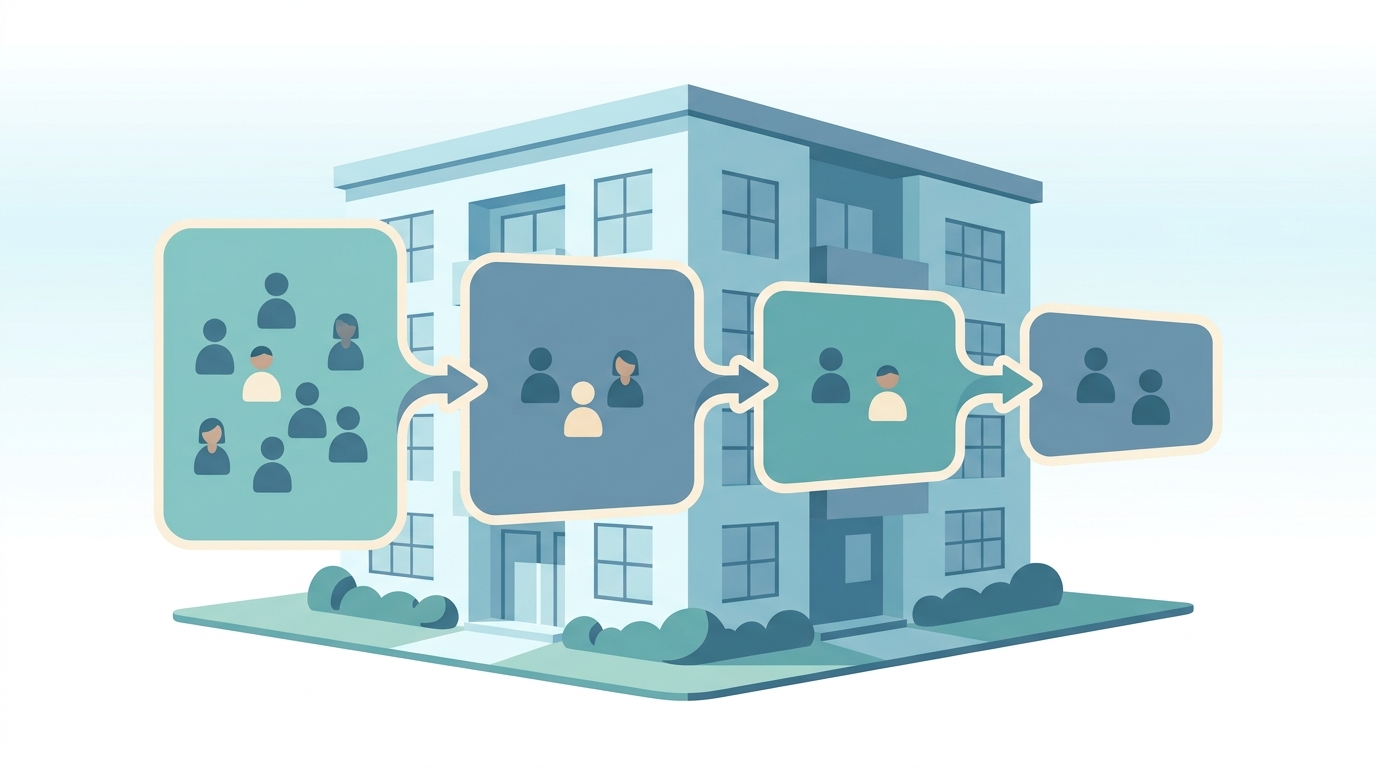
Lead-to-lease conversion rate (LCR) is the single number that tells you how well your entire leasing funnel works: LCR = signed leases ÷ total leads × 100. It's the connective-tissue metric that captures every upstream leak — scheduling friction, slow responses, ghosted applicants — in one place. And for most property managers, a low LCR isn't a volume problem. It's a speed problem. Every hour that passes before you respond, that renter is already applying somewhere else.
Why is your leasing funnel leaking — and where?
Here's the renter's reality right now: according to Zillow's 2024 Consumer Housing Trends Report, 66% of renters submit two or more rental applications. The majority of renters are hedging their bets across multiple properties at once. The typical renter takes just one in-person tour before deciding; one in five takes none at all. They're not waiting around. They're comparison-shopping in real time.
That changes what "leakage" means for your funnel. Leads don't go cold because of weak listings or bad photography. They go cold at specific, predictable moments — the moments when your operation is slowest. A prospect submits an inquiry at 7 pm on a Friday. Nobody responds until Monday morning. By then, they've signed a lease somewhere else.
The leaks aren't random. They cluster at the seam between "lead arrived" and "lead contacted" — exactly the stage most teams handle manually, inconsistently, and never after hours. That's the gap this piece maps out.
What is lead-to-lease conversion rate (LCR), and how do you calculate it?
The formula is straightforward:
LCR = (signed leases ÷ total leads) × 100
If you received 500 leads last quarter and signed 25 leases, your LCR is 5%. That number seems small, but it hides everything important — it's the product of every stage conversion stacked on top of each other.
That's what makes LCR the metric that matters: it's the only number that spans your entire funnel. A low contact rate, a poor tour-booking rate, a slow application process — each one chips away at LCR, and the final number reflects all of them at once. You can't game it by looking good at just one stage.
LCR is different from per-stage rates, which measure individual handoffs: what percentage of contacts book a tour, what percentage of tours lead to applications. Those per-stage rates tell you where you're leaking. LCR tells you how much you're leaking overall. Both matter, and Section 4 shows how they fit together.
What does a healthy lead-to-lease conversion rate look like?
The honest answer: no authoritative primary benchmark exists for residential property management LCR. If you've seen "8.7% average, 16.5% for top performers" quoted on PM software blogs, you've seen the same unsourced number recycled across dozens of sites — none with a traceable original study behind it.
That's not a gap to fill with a made-up number. It's a reason to reframe the question entirely.
The figure that matters isn't an industry average — it's your own LCR, measured month over month. A 5% LCR trending to 7% over three months means your funnel is improving. A 5% LCR that's been flat for a year means something structural isn't working. Chasing someone else's benchmark tells you nothing about where your specific funnel is leaking or what to fix first.
Industry blogs commonly cite residential LCR somewhere in the 5–15% range, which is plausible as a directional reference. But treat it as a rough orientation, not a target. Your own data, tracked consistently, is the only benchmark that's actionable.
Which leasing funnel metrics actually matter (and which are vanity)?
Raw lead count is the headline vanity metric in residential leasing. More leads sound good. But more leads fed into a leaky funnel just means more leads lost. If your contact rate is 20%, doubling your leads doubles your contacts — but it also doubles the 80% you never reached.
The metrics that actually matter map to the stages where conversions happen or die:
| Funnel stage | The metric that matters | Where it leaks | Realistic target |
|---|---|---|---|
| Lead → Contacted | Speed-to-lead + contact rate | Slow or after-hours response; no follow-up nudge | Respond within 5 minutes (see next section) |
| Contacted → Toured | Tour-booking rate | Friction to schedule; back-and-forth phone tag | Majority of interested contacts should book |
| Contacted → Applied | Application rate | Weak tour experience; no post-tour follow-up | Strong when the unit is a genuine fit |
| Applied → Leased | Lease/approval rate | Screening drag; applicants ghosted during review | Most qualified applicants should convert |
| Overall | LCR (lead → lease) | The cumulative product of every leak above | Your own month-over-month trend |
The vanity column: lead volume, listing impressions, "leads in CRM." They're inputs, not outcomes. The real metrics — speed-to-lead, contact rate, stage-by-stage conversion — are what tell you whether your funnel is working or bleeding.
How much does speed-to-lead really move your conversion rate?
This is where the data stops being directional and starts being striking.
A 2007 study from MIT's Sloan School of Management, the Lead Response Management Study, analyzed over 15,000 leads and 100,000 call attempts across six companies. The finding: responding within 5 minutes versus 30 minutes made you 21 times more likely to qualify the lead and 100 times more likely to make contact at all.
A separate 2011 study published in the Harvard Business Review audited 2,241 US companies across dozens of industries. Companies that responded within one hour were ~7 times more likely to qualify a lead than those who waited longer. Companies that waited 24 hours or more were more than 60 times less likely to qualify. The average first response time across all 2,241 companies: 42 hours. Only 37% responded within an hour.
Two different studies, two different methodologies, two separate findings — the 21× figure is the MIT 2007 data; the ~7× figure is the HBR 2011 data. They're both right, measuring different comparison points. The consistent message across both: the gap between "fast wins" and "almost nobody is fast" is enormous, and it's still there.
For a residential PM, the implication is direct. When the majority of your renters are submitting applications to multiple properties — 66% submit two or more (Zillow 2024) — and the average company takes 42 hours to respond, you're not losing leads to bad listings. You're losing them to the clock.
Why do most leasing funnels leak — and at which stage?
Across LetHub's 112 property manager discovery calls, one pattern emerged with unusual consistency: the number one named conversion killer was follow-up failure — not lead scarcity, not listing quality, not pricing.
A property manager running 1,100 units put it plainly: "We get anywhere from 500 to 1,000 leads a month… a very small percentage is actually followed up." That's not a funnel problem. That's a volume problem masked as a funnel problem — more leads arriving than the team can respond to, with no system to close the gap.
After-hours coverage was the second named gap. One PM described it directly: "My fear is that agents are not always available to answer calls, so I'm losing leads." Inquiries that land outside business hours sit untouched until morning — by which point, see Zillow's data above.
And then there's the structural limit of relying on people to follow up consistently: "Salespeople, as we know, do not follow up no matter what you do." That's a PM describing their own team without illusion.
The bottleneck isn't in the middle of the funnel — it's at the very first handoff. Lead → Contacted is where the MIT and HBR data bite hardest, and it's exactly where most teams are slowest. Every stage downstream of that first contact is secondary.
How do you diagnose a leaking funnel stage by stage?
Start with the table in Section 4 and pull your numbers for each stage. The process is straightforward:
- Pull your contact rate. Of all leads who inquired last month, what percentage did you actually reach? Your CRM or PMS call logs have this. If you don't have it, that's the first gap to close — you need response-time stamps.
- Pull your tour-booking rate. Of contacts made, what percentage booked a showing? A low number here usually points to friction: phone-tag scheduling, slow confirmation, no self-booking option.
- Pull your application rate. Of tours completed, how many applied within 48 hours? If this is low, look at post-tour follow-up — or the absence of it.
- Pull your lease rate. Of applications submitted, how many signed? A leak here usually means screening timelines are too long, or applicants aren't being kept in the loop during review.
Find the biggest single drop between stages. That's where your LCR is being lost. For most operations, it's at step one — the Lead → Contacted stage — because that's the only stage the data consistently and overwhelmingly points to. Start there. The other stages matter, but they can't save you if you're losing 60% of leads before you even make contact.
How do you fix a low lead-to-lease conversion rate without buying more leads?
The reframe first: you almost certainly don't have a lead problem. You have a 42-hour-average-response problem. Adding more leads to a funnel that loses most of them before contact just amplifies the waste.
The mechanism that closes the gap is a 24/7 instant-response system — every inquiry answered in approximately 30 seconds by text or chat, an AI voice agent that handles after-hours calls without sending callers to voicemail, and self-scheduling that lets prospects book a showing without waiting for a callback. These aren't nice-to-haves for a large operation. They're the direct counter to the specific failures the data describes: the 42-hour response average, the after-hours coverage gap, the follow-up that human teams skip under volume.
More lead spend into the same funnel will not move your LCR. Closing the first-response gap — the Lead → Contacted seam — will. That's where the leverage is, and the numbers are unambiguous about it.
LetHub is one option for that kind of coverage — AI leasing that answers every inquiry around the clock, auto-books ID-verified showings, and connects to the PMS systems residential PMs actually use. If you want to see what it looks like in practice, the link's below.
LCR exposes the leak; speed closes it. If your funnel isn't converting the way it should, start with your response time — the data on where to look is clear. See how answering every inquiry in ~30 seconds changes your lead-to-lease rate — book a demo.
Frequently asked questions
What is a good lead-to-lease conversion rate?
No authoritative primary benchmark exists for residential leasing LCR. Industry blogs cite roughly 5–15% as a general range, but those numbers lack a traceable primary source. A more useful target: benchmark against your own funnel month over month and track the direction of change.
How do you calculate lead-to-lease conversion rate?
Signed leases ÷ total leads × 100. If you received 500 leads and signed 25 leases, your LCR is 5%.
What is speed-to-lead?
Speed-to-lead is how fast you respond to a new inquiry. It's the single biggest lever on LCR — a 2007 MIT study found that responding within 5 minutes versus 30 minutes makes you 21 times more likely to qualify a lead.
Why do leasing leads go cold so fast?
The majority of renters submit applications to multiple properties — 66% submit two or more (Zillow 2024) — and they decide quickly. Meanwhile, the average company takes 42 hours to respond (HBR 2011) — by which point, most leads have already moved on.
What's the difference between lead-to-lease rate and a per-stage conversion rate?
LCR spans the entire funnel and captures the cumulative effect of every stage. Per-stage rates — contact rate, tour-booking rate, application rate, lease rate — show you exactly where within the funnel the losses are happening.
Which leasing metrics are vanity metrics?
Raw lead count, listing impressions, and "leads in CRM" are vanity metrics — they measure inputs, not outcomes. The metrics that matter are speed-to-lead, contact rate, and stage-by-stage conversion rates because they track where leads are actually won or lost.
Does responding faster really get more leases?
Yes, and the data is specific: responding within 5 minutes makes you 21 times more likely to qualify a lead versus 30 minutes (MIT 2007); responding within an hour makes you approximately 7 times more likely to qualify versus waiting longer (HBR 2011).
How do I improve LCR without spending more on leads?
Close the response gap: 24/7 instant first contact, after-hours call coverage, and friction-free self-scheduling for showings. Those three changes address the specific failure points the data most consistently identifies — and none of them require a bigger lead budget.
Leasing Automation Report
See LetHub on your own PMS and listings