Short answer: Yes — a self-showing lets a renter tour a vacant unit whenever they're actually free, evenings and weekends included. Close to a third of all leasing engagement happens after standard business hours, per NMHC survey data, and an unaccompanied tour is safe when it's gated by ID verification, a time-boxed code, and a logged entry.
A renter gets off work at six, picks up her kid, and doesn't open a rental listing site until 8:15 that night — the one free hour she has before the weekend hits. If the only way to see the unit is a showing booked during business hours, she waits until Saturday, tours three other places first, and applies wherever answered fastest. A 9-to-5 showing window doesn't just inconvenience that renter — it hands the unit to whoever showed it to her first.
When Do Renters Actually Search and Book a Tour?
Mostly after the same business hours a leasing office keeps. In NMHC's 2023 Customer Experience (CX) Technology Report — a survey of multifamily operators published with RealFoundations — almost one-third of all prospect engagement happens after-hours, outside the standard 9-to-5, Monday-through-Friday window.
That tracks with how renters actually spend their day. Most of them hold a 9-to-5 job themselves, which means the only stretch of time they have to browse listings, answer a text, or book a tour is the same evening and weekend window their landlord's leasing office is closed. It isn't a scheduling inconvenience — it's structural. The group that's free to book only exists outside the hours a traditional showing gets offered.
How Much Demand Does a 9-to-5 Showing Window Forfeit?
If showings only happen Monday through Friday, 9 to 5, that's 40 hours out of a 168-hour week — and it's the wrong 40 hours, because roughly a third of demand shows up in the 128 hours that window doesn't cover. Every renter who wants to see a unit at 7 p.m. or on a Saturday either waits days for an opening or tours a property that said yes tonight.
Self-guided touring has become the industry's answer to exactly that gap. In the same NMHC survey, 72% of operators reported offering self-guided tours — not as a novelty, but because staffing a leasing agent for every evening and weekend slot is expensive, and demand doesn't wait for a shift schedule. A vacant unit that can only be shown when staff are on the clock is, in practice, only for rent 40 hours a week.
What Makes a 7 PM Unaccompanied Tour Safe?
Three controls, run in order, every time: identity verification before access, a code that only works inside a defined window, and a full log of who came and went. Skip any one of them and an after-hours self-showing is just an unlocked door with better marketing.
The risk isn't hypothetical. The FTC's December 2025 data spotlight on rental scams found that scammers increasingly copy real self-tour listings and hand out a lockbox code to make a fake listing look legitimate — because a code alone proves nothing about who's holding it. Since 2020, the FTC has logged nearly 65,000 reported rental scams totaling roughly $65 million in losses, with a median loss of $1,000 per case, and renters aged 18 to 29 three times more likely than other adults to lose money to one.
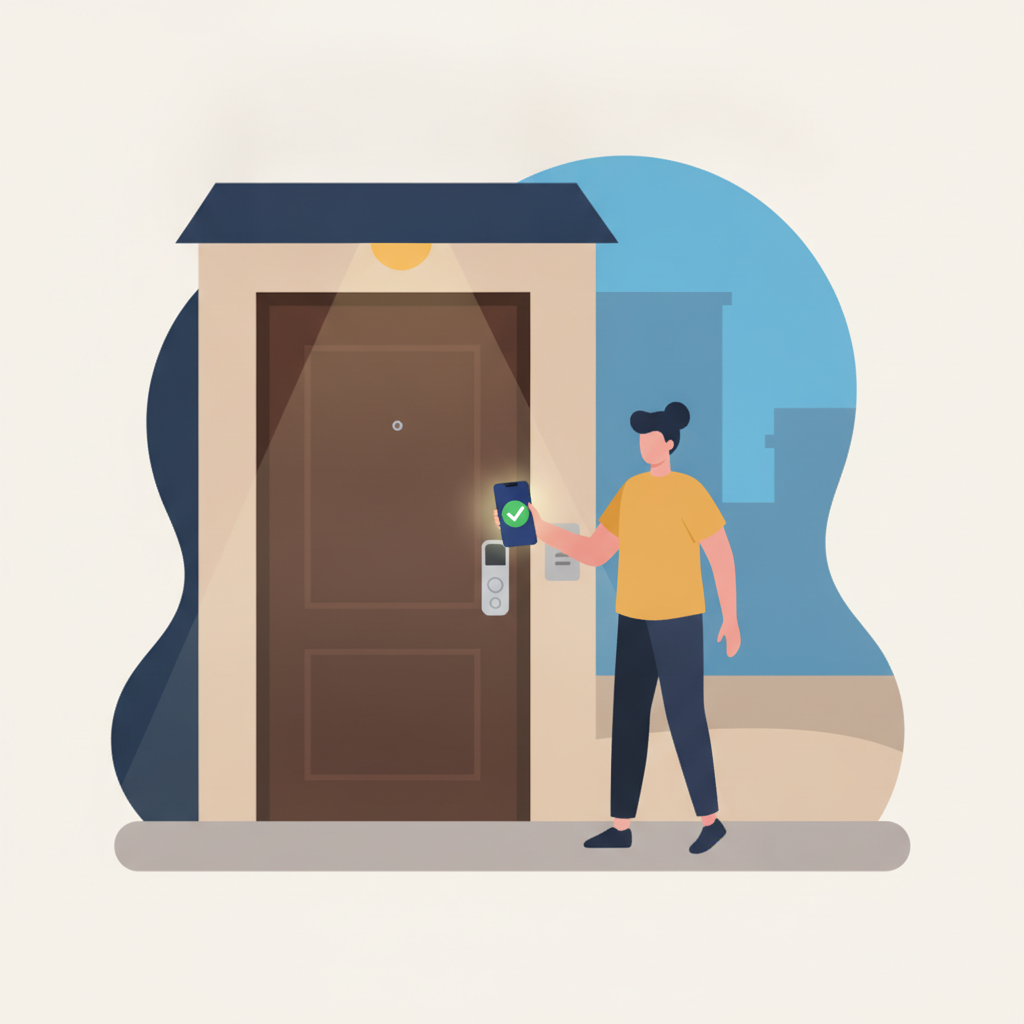
Bank-level identity verification — a government-ID scan plus a live selfie match — closes exactly the gap a bare code leaves open: it confirms the person requesting access is the person who shows up. Pair that with a time-boxed code that only works inside the confirmed showing window, and an entry log that timestamps when the door actually opened, and a 7 p.m. unaccompanied tour carries the same accountability as a staffed one at 2 p.m. — just without anyone on the clock to provide it. See how the full self-service showing flow handles this end to end.
Does a Self-Showing Require Smart Lockbox Hardware?
No. A smart lockbox makes single-use, auto-expiring codes simple, but it isn't the only way to run this safely. An ordinary offline lock with a static code works too — the difference is where the gate sits. With a smart lockbox, the code itself changes and expires. With an offline lock, the code stays the same, but the renter never sees it until they've cleared verification and their window opens. Either way, the part that matters — verify first, disclose the code only inside a confirmed window, log the entry — doesn't depend on the hardware behind the door.
That matters most for scattered-site portfolios, where retrofitting every door with a smart lock isn't realistic. A unit with an ordinary keypad lock can run the same after-hours, unaccompanied showing as one with a smart lockbox, because the security lives in the verification step, not the metal.
What Should a Property Manager Set Up First?
Start with the hours, not the hardware: open every vacant unit to touring evenings and weekends by default, since that's when a third of your demand is already trying to look. Then confirm the three controls are in place before the first after-hours code goes out — identity verification, a time-boxed access window, and a logged entry — regardless of whether the door has a smart lockbox or a static code.
LetHub runs exactly that sequence automatically: verified self-showings around the clock, with bank-level ID checks before any code releases, working with smart lockboxes and ordinary offline locks alike. See it running on a real unit — book a demo.
Frequently Asked Questions
Can renters tour a rental after hours or on weekends?
Yes. A self-showing separates touring from staffing — a verified renter can access a vacant unit any evening or weekend once they pass identity verification and their access window opens, with no leasing agent needed on-site. The tour happens whenever the renter is actually free, not whenever the office is staffed.
Is it safe to let a renter into a vacant unit alone at night?
It's safe when three controls run before access: a government-ID scan matched to a live selfie, a code that only works inside a confirmed time window, and a logged record of exactly when the door opened. Skip any of those and an unaccompanied tour is just an open door with no accountability behind it.
Do self-showings work without a smart lockbox?
Yes. Identity verification and time-boxed access work the same on an ordinary offline lock with a static code as they do on a smart lockbox — the gate is on when the code gets disclosed to a verified renter, not on the lock hardware itself. A scattered-site portfolio doesn't need to retrofit every door to run after-hours showings safely.
What percentage of leasing activity happens outside business hours?
Close to a third, per NMHC's 2023 Customer Experience Technology Report, published with RealFoundations: almost one-third of all prospect engagement with rental properties happens after-hours, outside the standard Monday-through-Friday, 9-to-5 window most leasing offices keep — which is exactly when a 9-to-5-only showing schedule loses renters.