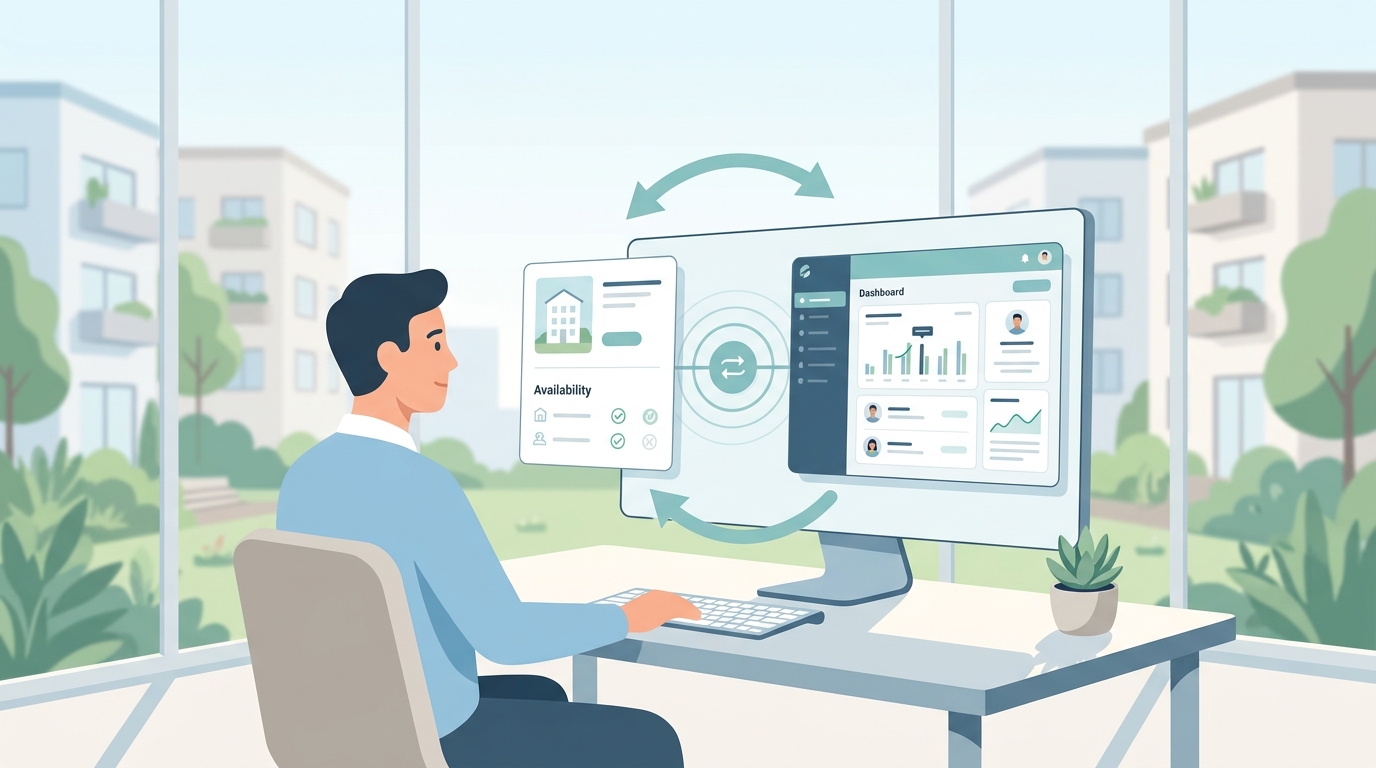
A deep PMS integration is two-way: it both reads your data (listings, units, availability) and writes back (creates the guest card, logs the tour outcome, updates status). A one-way integration only reads — so your team re-keys everything by hand. The one demo question that tells them apart: "Does it write the guest card back into my PMS, or just export a list?"
Across 112 discovery calls with residential property managers, one thing ended the conversation before price, features, or anything else got evaluated: integration depth. Not "does it integrate?" — every vendor says yes to that. The real question is how deep the integration goes. And most buyers don't find out until after go-live.
One PM told us on a call: "The integration piece would be a deal breaker." Another: "You don't integrate with our PMS, so I don't even know if that's a possibility." Both were evaluating tools that technically "integrated" — they just didn't write anything back.
This piece is the test you run before you sign anything. It works against any vendor, including us.
What Does "Two-Way PMS Integration" Actually Mean?
There are two kinds of PMS integration, and most marketing materials don't distinguish between them.
One-way (read-only) means the leasing tool pulls data out of your PMS — your listings, unit availability, pricing. A prospect inquires, the tool answers using that data, and the conversation happens entirely inside the tool. The lead lands there too. Your PMS doesn't know any of it happened.
Two-way (read + write) means the tool reads that same data and writes back. When the AI handles a lead, it creates or updates the prospect record in your PMS, logs what happened, records the tour outcome, and updates status. Your team opens the PMS the next morning and the work is already done.
The quiet cost of one-way integration: it doesn't eliminate the manual work it promised. It relocates it. Every lead still has to be hand-entered into your PMS, every tour outcome re-typed, every status updated twice — once in the tool, once in the system your team actually works from.
In our discovery calls, PMs consistently described this pattern: 500 to 1,000 leads a month, only a small fraction ever followed up on, re-keying eating the hours the tool was supposed to save. A one-way integration recreates exactly the bottleneck they bought the tool to escape.
What Is a Guest Card — and Why Writing It Back Is the Whole Game?
In AppFolio and many other property management systems, every inquiry becomes a guest card — the prospect record that captures name, contact, move-in date, properties of interest, pets, budget, and the history of every interaction. The guest card is where leasing teams actually work. It drives the workflow, the follow-up queue, the reporting.
A deep two-way integration creates or updates the guest card automatically. When the AI handles the inquiry, fields get populated: move-in date, pet situation, budget, tour booked, ID-verified status. Your leasing coordinator opens your PMS and the lead is already there, already qualified, tour already on the calendar.
A shallow one-way integration leaves the guest card blank. The lead exists in the leasing tool's dashboard, but your PMS — the system your team actually runs from — has no record of it. The AI did its job; your team now has a data-entry queue to clear before they can do theirs.
This is what "leads dumped into a spreadsheet" looks like in practice: it's a guest card nobody filled in. The AI handled the call. Nobody told the PMS.
If the integration doesn't write the guest card, you haven't saved the work. You've just deferred it.
[[cta]]
The One Question to Ask in a Demo (the GET vs. POST/PUT Test)
Every API integration is either reading data or writing it. Technically: it either sends a GET request (fetch/read) or a POST or PUT request (create/update). That distinction is the entire depth difference between one-way and two-way sync.
You don't need to know the API mechanics. You just need to ask the question that surfaces the answer:
"When the AI handles a lead, does it create or update the guest card in my PMS automatically — or do we still enter it by hand?"
A real two-way answer is specific: yes, it creates the guest card, and here's what it writes — name, contact, move-in date, tour booked, ID-verified flag. Some vendors will also confirm the API calls they use and show you the result live.
Watch for the dodge words: "it syncs," "leads flow into your dashboard," "it exports leads," "you'll have everything in one place." These describe reading data or surfacing it inside the tool — not writing it back into your PMS. They're one-way tells.
The table below makes the difference concrete:
| One-way (read-only) | Two-way (read + write) | |
|---|---|---|
| What it reads | Listings, units, availability | Listings, units, availability |
| What it writes back | Nothing | Guest card created/updated, tour outcome, status, ID-verified flag |
| What your team still does by hand | Re-keys every lead, re-types every tour outcome, updates status twice | Nothing — the record is already in the PMS |
| Where the lead ends up | A spreadsheet / the tool's dashboard | Your PMS, in the workflow your team works from |
What Should a Deep Integration Read — and What Should It Write Back?
When you're evaluating a leasing tool's integration, here's the checklist of what matters on each side.
What it should read from your PMS:
- Available units and listings
- Rent pricing and availability dates
- Property details (amenities, square footage, pet policies)
- Existing prospect records (to avoid duplicate entries)
What it should write back into your PMS:
- Create or update the guest card with the prospect's contact details, move-in date, budget, and preferences
- Log the conversation and any key notes
- Record the tour outcome — showed, no-show, booked
- Update lead status in real time
- Flag ID-verified status when self-showing access is granted
The write-back list is where most tools fall short. Reading your listings is straightforward. Writing a complete, accurate guest card back into the right unit's prospect queue is where the real API work lives — and where the manual re-entry tax hides when it doesn't happen.
There's also a speed-to-lead dimension. Research by Oldroyd and colleagues at MIT and InsideSales (2007) found that contacting a lead within five minutes versus thirty minutes yields roughly 21 times greater odds of qualifying it. Manual re-entry delays defeat this. If the AI responds to a lead in thirty seconds but your leasing coordinator doesn't see it in their PMS queue until they hand-enter it an hour later, you've lost most of that speed advantage before a human ever gets involved.
One-Way vs. Two-Way — What Changes in Your Day-to-Day?
The abstract distinction gets concrete fast when you picture Monday morning for a leasing coordinator.
With a one-way integration: The AI answered 40 inquiries over the weekend. The tool shows them in its dashboard. But the PMS — where the leasing team actually runs their day, checks their queue, sends follow-ups — has none of them. The coordinator's first hour is a re-keying session: copy name, paste email, enter move-in date, note the pet, log the tour. Then they start their actual work.
With a two-way integration: The same 40 inquiries are already guest cards in the PMS. Tour outcomes are logged. The qualified, tour-ready leads are right there in the queue. The coordinator skips the data-entry session entirely and starts on the warm ones.
Same AI. Very different operational reality. The integration is what decides whether the automation actually gave you time back — or just moved the work somewhere slightly less visible.
Does My PMS Even Support a Two-Way Integration?
Almost certainly yes. The question is whether the leasing tool you're evaluating actually built to it.
Nearly every major residential PMS exposes a REST API with real read and write capability. The limiting factor is usually the leasing vendor's implementation, not the PMS itself. Here's the current state by platform:
AppFolio exposes a full read+write REST API via its AppFolio Stack developer program. GET requests pull listings and unit data; POST/PUT requests create and update prospect records. Access typically requires a Plus or Max plan and partner program approval — confirm your plan tier directly with AppFolio.
Buildium offers a complete read+write REST API documented at developer.buildium.com. Full two-way sync is technically available, but is generally gated behind the Premium plan — confirm directly with Buildium.
RentVine provides a REST API with both read and write endpoints, allowing guest card creation and updates. API access is available through their developer program.
DoorLoop supports a REST API with read+write capability, typically accessible through an approval process via their developer documentation at DoorLoop's developer resources.
Propertyware exposes a REST API with read+write support for prospect records and leasing data.
TenantCloud has a more limited public API. The depth of available write-back is constrained compared to the platforms above — worth confirming directly with any vendor you evaluate.
The buyer takeaway: your PMS supports deep integration. The question is whether the leasing tool built to it — or just exports a list.
Canadian PMs: AppFolio requires a US-registered company, and RentVine doesn't currently serve Canadian operators (confirm with the vendor). If you're in Canada, lead with Buildium — it's the strongest read+write option available to Canadian operators.
Why Integration Is the #1 Thing Residential PMs Get Wrong When Choosing a Leasing Tool
Buyers evaluate the AI quality. They test the voice agent, watch the ID verification flow, ask about response time. All of that matters. But they often skip the one question that determines whether any of it actually reduces their team's workload.
The reason is simple: "does it integrate?" gets a yes from every vendor. Buyers check the box and move on. They never ask the depth question. The deal-killer isn't a missing integration — it's a shallow one discovered after go-live, when the leasing coordinator is still re-keying every lead two months into the contract.
In our 112 discovery calls, this was the pattern: PMs had tried tools, been disappointed, and come back to market. In most cases, they described the same failure mode — the tool worked, but the integration didn't run deep enough to actually change their team's workflow. The promise was automation. The reality was a new dashboard with a data-entry queue behind it.
LetHub runs deep two-way read+write sync back to most major property management software — which means it passes its own test. But run this test on anyone you're evaluating, including us.
[[cta2]]
How to Run the Two-Way Sync Test in Your Next Demo (5-Step Script)
This takes five minutes and works against any vendor. Run it before you agree to a pilot.
- Ask the depth question. "When the AI handles a lead, does it create or update the guest card in my PMS automatically — or do we still enter it by hand?" A real two-way answer is specific. A vague answer is a tell.
- Ask what it writes back. "Does it log the tour outcome? Does it update status in real time? Does it flag ID-verified?" Read-only tools go quiet here or redirect to their own dashboard.
- Ask them to show it live. Have them run a test inquiry during the demo and show you the guest card appearing or updating in your PMS sandbox. If they can't demo this live, that's your answer.
- Watch for the dodge words. "Syncs," "flows into your dashboard," "you can export leads," "everything in one place" — these describe reading or surfacing data, not writing it back. They're one-way tells.
- Confirm your plan tier. Check that your current PMS plan enables the API the tool needs. AppFolio typically requires Plus or Max; Buildium is generally gated behind Premium; DoorLoop typically requires going through their approval process — confirm the current requirements directly with each vendor. A deep integration on a plan that doesn't allow API access is a deep integration you can't use.
Frequently Asked Questions
What is a two-way PMS integration?
A two-way PMS integration both reads data from your property management system (listings, availability) and writes data back to it (creating or updating prospect records, logging tour outcomes, updating status). One-way integrations only read — they don't write anything back to your PMS.
What is a guest card in AppFolio?
A guest card in AppFolio is the prospect record created for every new inquiry — it captures name, contact information, move-in date, properties of interest, pets, budget, and the history of all interactions. It's the core object the leasing workflow is built around.
How can I tell if a leasing tool's integration is one-way or two-way?
Ask directly: "When the AI handles a lead, does it create or update the guest card in my PMS automatically, or do we still enter it by hand?" Then ask them to show it live in the demo. Dodge words like "syncs," "exports leads," or "flows into your dashboard" usually indicate a read-only (one-way) integration.
Does AppFolio support a two-way API integration?
Yes — AppFolio's Stack developer program exposes a full read+write REST API that allows creating and updating prospect records, logging tour outcomes, and updating lease status. Access typically requires an AppFolio Plus or Max plan and partner program approval — confirm current tier requirements with AppFolio directly.
Does Buildium support two-way integration?
Yes. Buildium's REST API (documented at developer.buildium.com) supports both read and write operations, including guest card creation and updates. Full API access is generally gated behind the Buildium Premium plan — confirm current requirements with Buildium directly.
What about DoorLoop, RentVine, Propertyware, and TenantCloud?
DoorLoop, RentVine, and Propertyware all expose read+write REST APIs that support true two-way sync, though DoorLoop typically requires going through an approval process for API access — confirm current requirements directly with DoorLoop. TenantCloud has a more limited public API, so two-way depth varies — confirm directly with any vendor you're evaluating against TenantCloud.
Why does integration depth matter more than the AI itself?
The AI handles the conversation. The integration determines whether your team actually saves time or just inherits a data-entry queue. A great AI with a one-way integration relocates the manual work — it doesn't remove it.
Does a one-way integration actually save time?
Not as much as it appears to. One-way integrations remove the AI's response burden from your team, but every lead still has to be hand-entered into your PMS, every tour outcome re-typed, every status updated twice. The re-keying work doesn't disappear — it just moves downstream.
Which PMS should Canadian PMs choose for a deep integration?
Buildium is the strongest choice for Canadian operators. AppFolio requires a US-registered company, and RentVine doesn't currently serve Canadian operators (confirm with the vendor). Buildium's Premium plan is generally available to Canadian PMs — confirm current tier requirements with Buildium directly.
Does LetHub have a two-way PMS integration?
Yes. LetHub runs deep two-way read+write sync back to most major property management software — so leads, tour outcomes and status land in the system your team already works from, instead of a separate dashboard. Run the five-step test above on any demo, including ours.
The test costs nothing and protects you from the most expensive mistake in this category: choosing a tool whose integration only reads. Run this test in your next demo — including ours.
Leasing Automation Report
See LetHub on your own PMS and listings