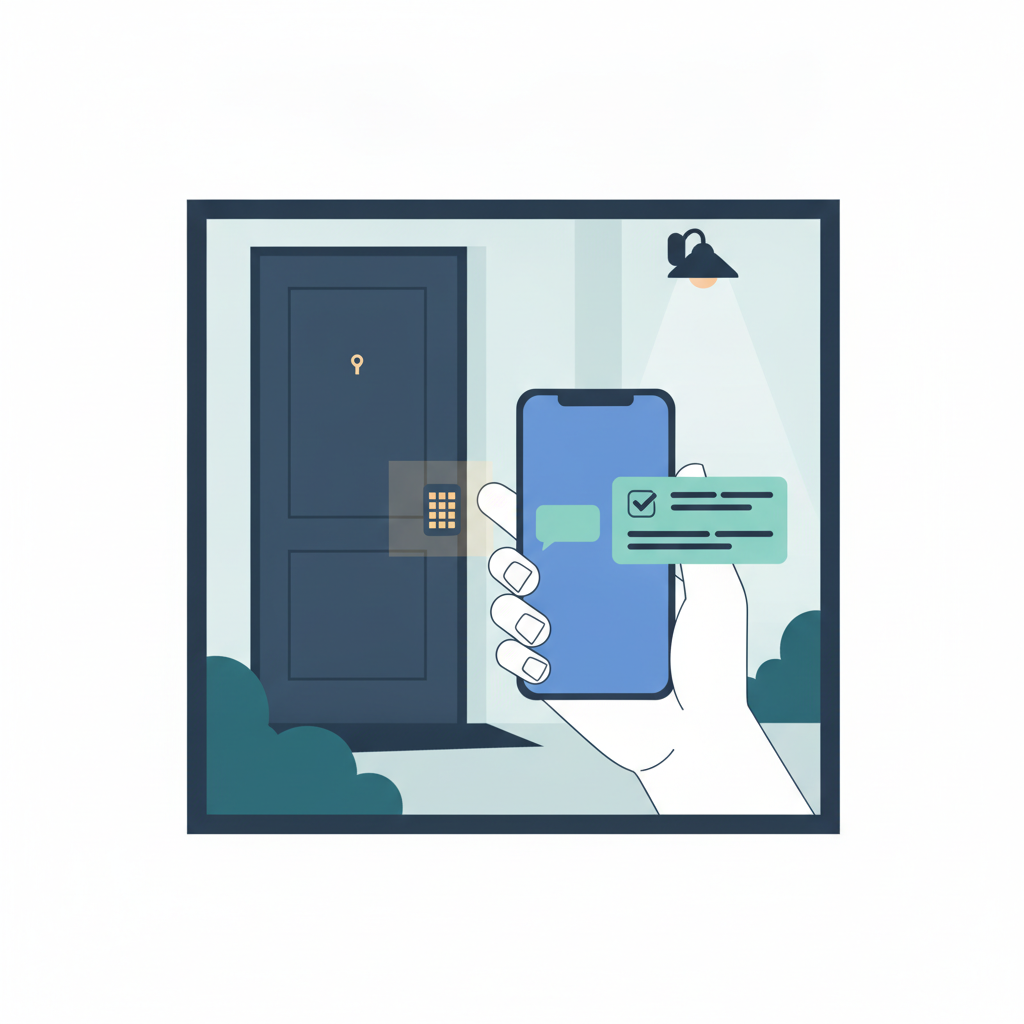
Six links, and DoorLoop is only the first one. Listings sync in; an AI agent answers the inquiry in about 30 seconds, day or night; the showing auto-books into a confirmed window; a government ID and live selfie verify the renter; the code goes out only inside that window; the outcome routes back to your team.
A prospect finds a listing synced in from DoorLoop and taps "Request a Self-Showing" at 9:40 on a Tuesday night. If what happens next is someone texting a lockbox code the following morning, the workflow isn't broken. It stops at the calendar. DoorLoop did its half: its site advertises "Syndicate to Zillow, Trulia, Hotpads & more" (as published August 2026 on doorloop.com), which is how it got found. The other half is everything after the tap.
What Does a Complete Self-Showing Workflow Look Like With DoorLoop?
One system of record; one showing platform running the rest:
| Step | What Happens | Runs In |
|---|---|---|
| 1. Sync | Listings and availability sync in from DoorLoop | DoorLoop → LetHub |
| 2. Inquiry | Text, chat and phone answered in about 30 seconds, 24/7 | LetHub |
| 3. Booking | The self-showing auto-books into a confirmed window | LetHub |
| 4. ID check | Government ID plus live selfie match, before any code reaches the renter | LetHub |
| 5. Access | The code (smart lockbox or offline static code) is released only inside the booked window | LetHub + lock hardware |
| 6. Reporting | Visit outcome and notes route back to the leasing team | LetHub |
Only step 1 touches DoorLoop. The rest runs beside it.
Does Listing Syndication Cover the Showing?
It covers being found: the harder half to buy, the easier half to leave unfinished. Renters shop in parallel: 66% of recent renters submitted two or more rental applications in 2023, up nine points from 57% in 2022, per Zillow's 2024 Consumer Housing Trends Report, whose own conclusion is that as multiple applications get easier, "responding quickly with clear next steps is critical." Syndication puts your unit in the comparison set. Who answers first, with an actual time, decides it.
How Fast Does an Inquiry on a DoorLoop Listing Get Answered?
In roughly 30 seconds across text and chat, and an AI voice agent picks up the phone the same way: a real conversation, not hold music (try the live line: 404-383-6213). The market sets what that speed is worth: the national rental vacancy rate was 7.3% in Q2 2026, statistically unchanged from 7.0% a year earlier, at a median asking rent of $1,531, per the U.S. Census Bureau's Q2 2026 Housing Vacancy Survey (CB26-116, July 28, 2026). Not a spike. A steady one-in-fourteen rentals sitting open.
How Does ID Verification Protect an Unaccompanied Showing?
In NMHC's 2024 Pulse Survey on Fraud, 93.3% of the 75 responding NMHC/NAA members reported fraud in the prior twelve months, and of those who saw it, 70.0% reported identity theft, fraudulent ID documents, or use of someone else's personal information. That panel is large apartment owners and managers, not scattered-site shops, so read it as a direction, not a rate for your doors. But direction is what matters when nobody's standing at the door.
So identity goes first: a government ID scan plus a live selfie match, before the renter has a code. One honest caveat about hardware: a smart lockbox can issue and retire codes, while an offline lock's static code does not expire on its own. What's bounded there is disclosure: the code is released only to a verified renter, inside their window. Rotating it on a schedule is what ends its life.
Does Leasing Run Inside DoorLoop, or Beside It?
Beside it, deliberately. DoorLoop stays the system of record for the portfolio, the books and the tenant portal. LetHub syncs with DoorLoop, pulling the property list and availability so a unit marked available shows correctly for booking without being re-entered, while the inquiry, booking, ID check and access step happen in LetHub's own system. No second lead record for anyone to reconcile.
Want to see it on a real listing? Book a demo.
Frequently Asked Questions
Do self-showings with DoorLoop require a smart lockbox?
No. An ordinary offline lock with a static code works, and identity is verified before that code is released either way. The difference is housekeeping: a static code doesn't expire by itself, so it gets rotated on a schedule rather than retired after each visit.
Does any of this create records inside DoorLoop?
No. LetHub syncs listings and availability in from DoorLoop, then runs the inquiry, booking, verification and access steps in its own system. Nothing new appears in DoorLoop for a bookkeeper to reconcile at month end, and the data only ever moves in one direction.
How fast does the AI answer a DoorLoop listing inquiry?
In about 30 seconds, 24/7, across text, chat and phone, with an AI voice agent answering calls the same way, instead of waiting for someone to open a shared inbox the next morning, by which time the renter has toured somewhere else.
Does DoorLoop's listing syndication replace this workflow?
No. Getting a listing seen and handling what happens after someone taps "tour this unit" are separate jobs. Syndication does the first. This workflow does the second: the reply, the confirmed time, the identity check, and the code on the door.