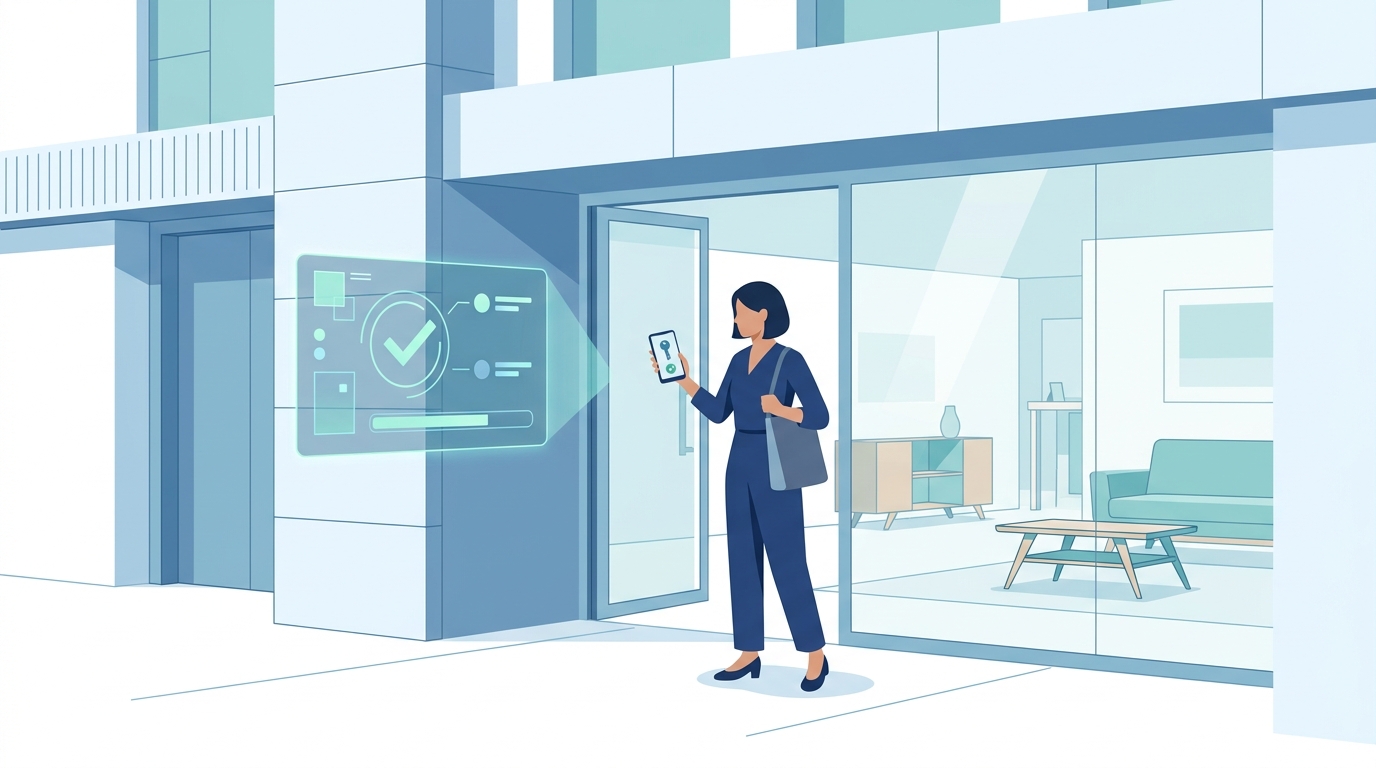
In 2026, renters expect leasing to be instant, self-service, mobile-first, and available outside business hours. They want a reply in minutes, a tour they can take themselves, an apply-and-sign flow on their phone — and they inquire nights and weekends. The problem: those four demands converge into one always-on expectation a 9-to-5 team can't meet.
A renter messages a listing at 9 p.m. on a Saturday. By Tuesday morning, when your leasing coordinator follows up, that renter has already toured somewhere else and submitted an application. The unit sits vacant another week.
That's the gap between what renters expect now and what most leasing operations are built to deliver. Renter standards have moved fast — shaped by on-demand everything, from same-hour food delivery to instant bank transfers. Leasing is being measured against all of it.
What's changed isn't one new expectation. It's four: instant replies, self-guided tours, mobile-first applications, and after-hours availability. They all point in the same direction — the renter expects leasing to work whenever they show up, without waiting for a person to become available. Here's what each expectation looks like, the data behind it, and why meeting all four at once is structurally hard for a human-staffed team.
How fast do renters expect a reply when they inquire?
Minutes, not hours. Renters compare leasing response times to every other digital interaction — rideshare apps, food delivery, instant bank transfers. A 24-hour leasing callback feels like a different era when everything else replies in seconds.
Dr. James Oldroyd's foundational study (MIT and InsideSales.com, ~15,000 leads, ~2007) found that contacting a lead within 5 minutes versus 30 minutes made you 100 times more likely to reach them and 21 times more likely to qualify them (Lead Response Management Study (archived)). Harvard Business Review later reported the same research, noting that responding within an hour of an inquiry made you 7 times more likely to qualify that lead than waiting just one more hour.
The first team to respond meaningfully almost always wins the inquiry. A renter who gets a real answer in two minutes while three other listings sit silent has already started deciding. That dynamic becomes more pointed when you see where most inquiries actually land — the timing and after-hours data below.
Do renters want to tour rentals on their own, without an agent?
Yes — and that preference has crossed from fringe to mainstream fast. Self-guided tours were a pandemic-era adaptation renters turned out to actually prefer.
The NMHC/Grace Hill Renter Preferences Survey tracks this shift. In 2020, 16% of renters preferred a self-guided tour for their next search. By 2022, 39% of renters had used a self-guided tour in their most recent apartment search — a jump that held in 2024, when 38% still reported having used one. After a sharp rise from 2020 to 2022, self-guided touring has stabilized at roughly four in ten renters — not a fringe preference, a mainstream one.
Self-guided touring isn't just about convenience — it's about decoupling access from staff availability. A renter who can tour at 8 p.m. on a Tuesday doesn't need to negotiate an agent's calendar. They show up when it works for them. That's the same logic driving the after-hours inquiry data in the next section: self-touring is the physical form of the always-on expectation.
[[cta]]Is the rental search now mobile-first?
The whole funnel — search, narrow, apply, sign — now happens primarily on a phone. That's not a future state; it's where renters are today.
According to the Zillow Rentals Consumer Housing Trends Report 2025, 81% of recent renters used a mobile website to search for their rental, and 73% used a smartphone or tablet app — a +17-percentage-point rise in mobile app use since 2019. Renters aren't just browsing on mobile; they're doing the whole job there.
The Zillow Rentals Consumer Housing Trends Report 2024 fills in the transactional end: 67% of renters want to apply for a rental online, 51% want to sign their lease digitally, and 86% narrow their options online before ever contacting a property manager.
These numbers describe a renter who has already done most of the work before contacting you — and expects to finish the rest on their phone. An application that requires a PDF or an in-person signing asks the renter to step back into a different era. Most won't; they'll move to the next listing. And since most mobile search activity happens in the evenings and on weekends, it ties directly into the timing problem in the next section.
When do rental inquiries actually come in — and why does that break a 9-to-5 team?
Here's the reframe that matters most: the renter-expectation gap isn't just a tooling gap. It's a timing gap. Your team can have great processes, fast replies during business hours, and well-prepared showings — and still structurally miss most of your leads, because most leads don't arrive during business hours.
Industry data on anonymized scattered-site rental inquiry timing shows that approximately 56.8% of rental inquiries arrive outside the standard 9-to-5 window — before 9 a.m., after 5 p.m., or on weekends. The same analysis found that 22.5% of renter contacts arrive on weekends specifically. The majority of your leads land when your team isn't at a desk.
A phone call at 7 p.m. Friday rings into voicemail. A message at 10 p.m. Thursday waits until morning. By then, the renter has already heard back from the listing next door — or moved on entirely.
After-hours availability isn't a premium feature at this point. It's the window where most leasing conversations need to start — and it's precisely where human staffing has its hardest structural limit. You can't economically staff a full leasing team across every after-hours hour, and even if you could, the 5-minute speed bar from the Oldroyd research isn't achievable by a person who has to be woken up to answer the phone.
Does responding faster really win more leases?
Yes — and the after-hours timing data sharpens the stakes considerably.
The speed-to-lead research says the lead is most winnable in the first 5 minutes. The timing data says more than half of leads arrive when no one is staffed to respond that fast. Together: a human-only 9-to-5 leasing operation is structurally late on the majority of its leads, because those leads arrive outside the window where fast response is even possible.
Meeting any one of the four expectations — instant replies, self-guided tours, mobile-first applications, after-hours availability — isn't impossible for a human team. Meeting all four, simultaneously, on every inquiry, at every hour, is not solvable by training staff better or asking them to check their phones more often. It's a structural problem. The four collapse into one requirement: be there, with a useful response, whenever the renter shows up.
[[cta2]]What does a modern, renter-expected leasing experience look like end to end?
If you map the four expectations onto a single renter journey, the picture is straightforward — and the contrast with a traditional leasing workflow is obvious:
- Inquiry arrives at 9 p.m. → the renter gets a real reply in ~30 seconds, any day or hour. Not a voicemail or an auto-reply with office hours — an actual response.
- The renter books and completes a self-guided tour on their own schedule — evenings included — without coordinating with an agent's calendar. Identity is verified before access, so the property is protected.
- The renter applies and signs on their phone. No PDF, no fax, no in-person appointment. The entire funnel completes on the device they used to find the listing.
This is no longer aspirational — it's the baseline some properties already offer. Closing the gap is an operational-design choice, not a headcount one: automate the parts that have to be always-on, keep the human team on what actually requires judgment.
How can a small or mid-size PM meet these expectations without hiring more staff?
More staff on more shifts doesn't solve a structural timing problem — it just makes it more expensive. Even if you could cover every after-hours hour, the 5-minute speed bar still requires someone immediately available to respond.
What closes the gap is automating the two legs that have to be always-on: the first response and the tour. An AI that replies to every inquiry in ~30 seconds by text, chat, or phone — any hour, any day. A 24/7 AI voice agent so the Friday 7 p.m. phone call doesn't go to voicemail. Auto-booked, bank-level ID-verified self-guided showings so renters tour on their schedule, not an agent's. A mobile-complete apply-and-sign flow so nothing requires an in-person visit.
The human team stays focused on what actually needs them: qualification calls, lease review, closing. The always-on parts run without them.
LetHub is built for exactly this. See how it handles the gap in practice — AI replies in ~30 seconds, after-hours voice, ID-verified self-showings — book a demo.
Frequently asked questions
What do renters expect from a leasing experience in 2026?
Instant replies, self-guided touring, mobile-first apply-and-sign, and after-hours availability. The four demands converge into one always-on expectation: be there, with a useful response, at whatever time the renter shows up.
How fast should a property manager respond to a rental inquiry?
Within minutes. Dr. James Oldroyd's foundational research (MIT/InsideSales.com, ~2007) found that contacting a lead within 5 minutes versus 30 minutes made you 100 times more likely to reach them and 21 times more likely to qualify them (Lead Response Management Study). The first responder usually wins.
What percentage of rental inquiries come in after hours?
Industry timing data on anonymized scattered-site rental inquiries shows approximately 56.8% arrive outside standard business hours — before 9 a.m., after 5 p.m., or on weekends. Weekend contacts account for 22.5% of all renter inquiries specifically.
Do renters prefer self-guided tours?
In 2020, 16% of renters preferred a self-guided tour. By 2022, 39% had used one in their most recent search — a figure that held at 38% in 2024, per the NMHC/Grace Hill Renter Preferences Survey. Roughly four in ten renters now use self-guided tours as a matter of course.
Is renting now a mobile-first process?
Yes — 81% of renters searched via mobile website and 73% via a smartphone or tablet app, up 17 percentage points in app use since 2019 (Zillow CHTR 2025); 67% want to apply online and 51% want to sign digitally (Zillow CHTR 2024).
Does responding faster actually win more leases?
Yes. Speed-to-lead data consistently shows the first meaningful responder has a dramatically higher chance of reaching and qualifying the prospect — in leasing, the team that replies first with a real answer, not an auto-reply, typically wins the inquiry.
Why can't a 9-to-5 leasing team meet these expectations?
Because more than half of inquiries arrive outside business hours, and the speed bar (under 5 minutes) is only achievable if someone is immediately available to respond — a 9-to-5 team is staffed precisely when most renters aren't inquiring.
How can a small PM offer 24/7, instant leasing without hiring more staff?
Automate the two always-on legs: the first response and the self-guided tour. An AI that replies in ~30 seconds to any inquiry, a 24/7 AI voice agent for after-hours calls, and ID-verified self-showings remove the bottlenecks that require a human to be immediately available.
Leasing Automation Report

See LetHub on your own PMS and listings