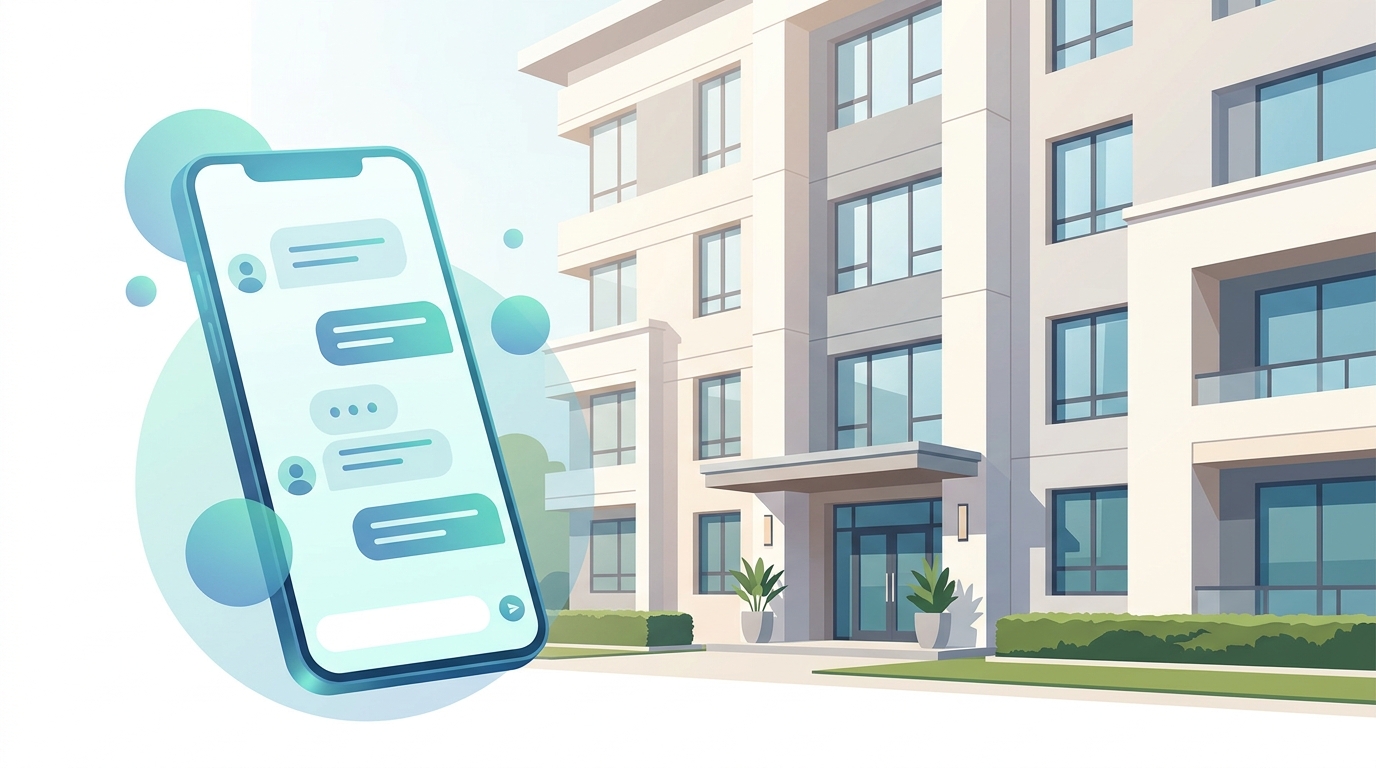
AppFolio already captures and dedupes a guest card for every inquiry — its weak point is what happens after capture: the after-hours guest card nobody answers, no voice agent, no ID-verified self-showings. An AI leasing layer that runs with AppFolio adds roughly 30-second replies 24/7 across text, email, and phone, gated showings, and two-way sync back to the same guest card — no duplicate record.
A guest card lands at 9pm on a Saturday. A renter found your listing on Zillow, had a question about the unit, and sent an inquiry. AppFolio files the guest card perfectly — the record is there, clean, deduplicated. But nobody replies until Monday morning. By then, the renter has toured the property down the street that answered in five minutes.
The gap was never about capturing the lead. AppFolio is built to catch every guest card from every ILS and syndication source. The problem is what happens after capture — specifically, what happens to the guest card that arrives outside office hours, or on a Sunday, or during a leasing agent's lunch break. That card waits. The renter does not.
The data on lead response is blunt. The average company takes roughly 42 hours to respond to an inbound web lead, and 23% never respond at all. Contact a prospect within five minutes and you are 21 times more likely to qualify them than if you wait 30 minutes — the core finding of the 2007 MIT/InsideSales Lead Response Management study by Dr. James Oldroyd. A missed inquiry window is not a delayed lead — it is a lost one.
This guide covers what AppFolio's built-in leasing assistant does and where it stops, what the after-hours problem actually costs, and the four things a good AI leasing layer adds on top of AppFolio — including the one that PMs worry about most: what happens to the guest card.
What Does AppFolio's Built-In Leasing Assistant Actually Do — and Where Does It Stop?
AppFolio's built-in leasing assistant is genuinely useful at what it is designed to do. The platform automatically creates a guest card when an inquiry arrives from a connected ILS or syndication source — Zillow and others — and is built to manage duplicate entries so your prospect database stays clean. If someone inquires from two sources on the same unit, AppFolio handles the deduplication. That is a real operational benefit: one record per prospect, no manual reconciliation.
The platform serves a substantial install base. As of December 31, 2024, AppFolio reported 8.7 million units across 20,784 customers, per its Form 10-K FY2024. When you are building a leasing layer alongside a PMS, the size of that install base matters — both for the integration depth you can expect and for the community of PMs sharing the same operational constraints.
Where the native assistant stops is where the requests from property managers start. In discovery conversations with AppFolio shops across the US and Canada, the gap PMs name most consistently is not the guest-card capture — it is the silence after capture: nobody answering late in the evening, no voice agent on the leasing line, and no ID verification before a lockbox code goes out. The native assistant handles capture and initial conversation flow. It was not designed to answer the leasing line at midnight, conduct a full prequal over voice, or gate a self-showing behind bank-level ID verification.
The fix is not ripping out the native system. It is adding a layer that runs with AppFolio — covering the after-hours window, the voice calls, and the self-showings — and writing that activity back to the same guest card that AppFolio already created.
What Is the "After-Hours Guest Card" Problem — and What Does It Cost You?
In the leasing world, the after-hours guest card is the inquiry that arrives outside office hours: a weeknight evening, Saturday afternoon, a Sunday morning when your leasing agent is off. The renter who sends that inquiry is not waiting for you to open on Monday. They are comparing three listings tonight and booking whichever one answers them first.
This is not a hypothetical. In the residential single-family market, days-on-market for SFRs jumped 15.4% year-over-year in the first half of 2024, according to HouseCanary's 2024 National Rental Report. Yardi Matrix's April 2024 data puts the national average SFR rent at $2,154 — that is the monthly revenue on the line for every unit sitting dark. Every slow guest-card response carries that cost.
Connect that back to the lead-response window above. The five-minute contact threshold is not about being fast for its own sake — it is about catching prospects while they are still actively engaged. An unanswered inquiry does not delay a lead. It routes that lead to whoever did answer. Your AppFolio guest card is perfectly filed, fully deduplicated, and entirely unresponded to.
So what should an AI leasing layer actually add on top of AppFolio to close that gap?
[[cta]]
What Should an AI Leasing Layer Add on Top of AppFolio?
A good leasing layer does not replace what AppFolio does well. It covers the four things the capture-and-file system was never designed to do.
1. A roughly 30-second response to every guest card, 24/7 — across text, email, and phone
Not "fast during office hours." Every inquiry answered in the window when the renter is still on the listing, at whatever hour they send it. The response needs to cover all three channels because renters do not pick one — they inquire however the listing makes convenient.
2. An AI voice agent that answers the leasing line
Chat and SMS cover a lot of ground, but many prospects still call. The leasing line that goes to voicemail after hours loses those callers immediately. An AI voice agent that answers 24/7 — has a real conversation, handles prequal questions, and books the showing on the call — closes that gap. This is not an IVR phone tree. It is a voice agent that can complete the full leasing intake by phone.
3. Self-showings gated by bank-level ID verification
Unattended touring cuts no-shows and frees up leasing agents. The reason many PMs hesitate is the scam risk: handing a lockbox code to an unverified stranger is a real exposure. Bank-level ID verification gates the showing — the prospect verifies their identity before any code is released — so self-showing convenience does not mean unscreened access.
4. Two-way PMS sync that writes back to the existing guest card — no duplicate record
This is the one PMs quietly worry about most. The AI handles the conversation, books the tour, runs the prequal, and completes ID verification — and all of that activity lands back on the same guest card AppFolio already created. One card, enriched. Not a second copy sitting in a parallel system your team has to reconcile.
These four are the definition of a leasing layer that runs with AppFolio, not alongside it as a competing database. The two-way sync is what makes the rest of them coherent — and it is covered in detail next.
Does a Third-Party AI Assistant Create Duplicate Guest Cards in AppFolio?
When property managers consider bolting on a third-party AI leasing tool, this is often the concern that comes up first — not "will it respond fast" (plenty of tools claim that), but "will it pollute my guest-card database with duplicate records that I have to clean up manually?"
The concern is legitimate. AppFolio built its deduplication logic specifically because duplicate guest cards are a documented operational problem. The platform handles it at the ILS/syndication layer precisely because, without that logic, a prospect who inquires from Zillow and from an email form can end up as two separate records. AppFolio resolves that. PMs who have lived with the clean database do not want a third-party tool to break it.
The credible answer depends entirely on how the leasing layer is designed. The right design reads the existing guest card — who the prospect is, which unit they inquired about, where the inquiry came from — and writes the AI's activity back onto that card. Replies sent, showing booked, prequal answers collected, ID verification result. All of it lands on the record AppFolio already created. One card, enriched — not a second contact.
A layer designed that way does not introduce duplicate records. It enriches the record AppFolio is already managing. The question to ask any leasing AI vendor is not whether they integrate with AppFolio — most claim they do — but specifically: does activity write back to the existing guest card, or does your tool create a new contact record?
[[cta2]]
Can an AI Agent Answer the Phone for Leasing — Not Just Text and Email?
Yes — and this is one of the gaps that chat and SMS tools leave open. A meaningful share of rental inquiries still come in by phone: the renter who calls the number on the sign, the one who found the listing and preferred to ask a question verbally before booking. The leasing line that goes to voicemail after hours loses those callers outright.
An AI voice agent answers the leasing line 24/7. Not a phone tree that routes to a menu — a voice agent that has a real conversation, answers questions about the unit and availability, collects prequal information, and books the showing on the call. The prospect who calls in the evening gets answered and booked the same as the one who texted at noon.
The call activity — what was discussed, what prequal answers were collected, whether a showing was booked — writes back to the AppFolio guest card alongside the SMS and email interactions. Your leasing team sees a unified record regardless of which channel the prospect used.
How Do ID-Verified Self-Showings Work Alongside AppFolio?
The self-showing tradeoff most PMs describe is straightforward: unattended tours cut no-shows and free up leasing agents from escorting every prospect through a unit. The reason many PMs stay away from them is the exposure — releasing a lockbox code to an unverified stranger is the scam vector that makes self-showings feel risky.
Bank-level ID verification closes that gap. Before any showing code is released, the prospect verifies their identity — the same verification standard used for financial accounts. A scammer who cannot pass identity verification does not get access to the unit. The PM gets self-showing convenience without handing out access to unscreened strangers.
The showing process runs alongside AppFolio, not in a separate tool your team has to check. The prequal answers collected before the showing, the ID verification result, and the confirmed tour all write back to the AppFolio guest card. When your leasing agent opens the record, they see a prospect who has been prequal'd, ID-verified, and has already toured the unit — ready for the next step.
This is the connection between the self-showing layer and the two-way sync: the guest card that your team manages in AppFolio carries the full picture, not just the initial inquiry.
Is This Locked to AppFolio, or Does It Travel If You Change Software?
Because the leasing layer runs with your PMS rather than living inside one platform, it is not bolted to AppFolio. The core capabilities — voice, 24/7 text and email response, self-showings, ID verification — sit alongside the PMS and connect to it for guest-card read and write.
That matters for property managers who may switch software, grow into a different platform, or manage portfolios across systems. The leasing engine works with the major residential PMSs — AppFolio, Buildium, DoorLoop, RentVine, and others — so the workflow you build does not disappear if your PMS changes.
This is also relevant for Canadian property managers, where US PMS integration is not a requirement. The leasing layer fits residential portfolios in both the US and Canada without needing to match a specific software stack.
The question is not which PMS you are on. The question is whether your leasing workflow covers the after-hours inquiry, the voice caller, and the self-showing request — and whether the activity from all three makes it back to a single guest-card record your team can act on.
What Does It Take to Go Live With AppFolio — and How Is Pricing Set?
Going live is designed to be straightforward. Onboarding gets your leasing layer live after a Zoom call. The layer connects to your AppFolio guest cards, the AI starts answering inquiries, and activity begins writing back to the same records your team already manages. No parallel database to set up, no new system for your leasing agents to learn alongside AppFolio.
On pricing: it depends on portfolio size and how much of the leasing you automate, including how much voice coverage you need. We confirm the number with you directly, before anything starts.
The outcome: a leasing workflow that answers every inquiry in roughly 30 seconds, 24/7, handles voice calls and self-showings, and keeps a single clean guest-card record in AppFolio — without adding a second system for your team to maintain.
Frequently Asked Questions
Does this AI leasing layer work with AppFolio?
Yes. It runs with AppFolio as a leasing layer alongside your existing guest cards — not a replacement for the PMS, and not a plugin that lives inside it.
Will it create duplicate guest cards in AppFolio?
No. The layer writes activity back to your existing AppFolio guest card — one card, enriched with the AI's replies, tour bookings, and prequal results — not a second contact record.
What does an AI leasing assistant add that AppFolio's built-in assistant does not?
After-hours coverage across text, email, and phone; an AI voice agent that answers the leasing line 24/7; bank-level ID-verified self-showings; and two-way write-back to the existing AppFolio guest card — all without replacing the native system.
Can the AI answer leasing phone calls, not just texts and emails?
Yes. An AI voice agent answers the leasing line 24/7, conducts a real conversation, handles prequal questions, and can book the showing on the call — then writes the call activity back to the AppFolio guest card.
How fast does it respond to a new guest card?
Within roughly 30 seconds, 24/7, across text, email, and phone — so the after-hours or weekend inquiry gets answered in the window the prospect is still engaged.
How do ID-verified self-showings prevent rental scams?
Bank-level ID verification gates the showing before any lockbox code is released — the prospect confirms their identity first, so unverified access is blocked at the pre-showing step, not discovered after the fact.
Is the leasing layer locked to AppFolio?
No. It also works with Buildium, DoorLoop, RentVine, and other residential PMSs, so the leasing workflow travels with you if your PMS changes, and it fits Canadian portfolios that do not require specific US PMS integration.
What does it cost?
Pricing depends on portfolio size and how much of the leasing you automate, including voice coverage. We confirm the number with you before anything starts.
Stop losing the after-hours guest card. See how an AI leasing layer answers, verifies, and books showings alongside your AppFolio records — and writes it all back to the same guest card. Book a demo with LetHub.
Leasing Automation Report
See LetHub on your own PMS and listings